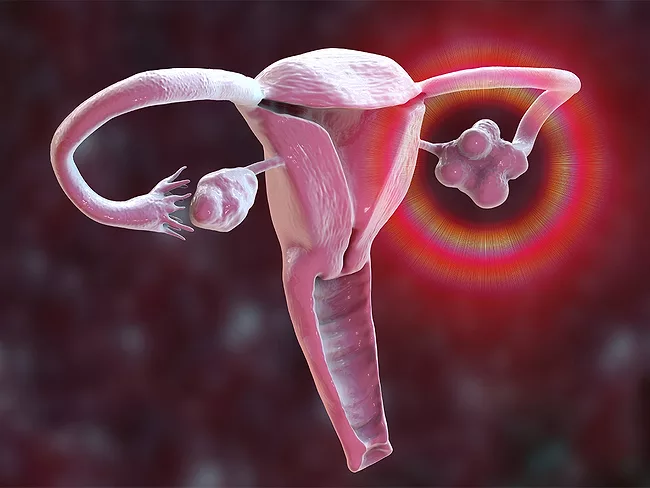
Although the causes of polycystic ovary syndrome (PCOS) are unclear, researchers know this condition leads to endometrial dysfunction in women who have hormonal imbalances, and insulin resistance. Now, a study led by scientists at the Karolinska Institutet in Sweden has revealed the cellular and genetic differences that distinguish this disorder in the first atlas of the human endometrium during the proliferative phase of the menstrual cycle.
Transplanting an animal organ into a human is now a closer reality following the successful xenotransplantation of a genetically modified pig liver into a patient diagnosed with brain death in China. The operation was intended to evaluate organ function over a 10-day period. This is a complex experimental trial that did not involve removing the patient's liver and still requires further study. However, the positive preclinical results suggest this strategy could save the lives of those waiting for a human organ, at least in certain cases.
In the brain, molecular information is transmitted between cells through neural circuits. Synapses establish connections between the pathways that run from one area to another, allowing the most complex organ in the body to fulfill different functions. Cells and neural circuits are the basic biological elements in the study of mental illness. However, the scientific community still does not know how to interpret their role in neuropsychiatric disorders.
Transplanting an animal organ into a human is now a closer reality following the successful xenotransplantation of a genetically modified pig liver into a patient diagnosed with brain death in China. The operation was intended to evaluate organ function over a 10-day period. This is a complex experimental trial that did not involve removing the patient's liver and still requires further study. However, the positive preclinical results suggest this strategy could save the lives of those waiting for a human organ, at least in certain cases.
Transplanting an animal organ into a human is now a closer reality following the successful xenotransplantation of a genetically modified pig liver into a patient diagnosed with brain death in China. The operation was intended to evaluate organ function over a 10-day period. This is a complex experimental trial that did not involve removing the patient's liver and still requires further study. However, the positive preclinical results suggest this strategy could save the lives of those waiting for a human organ, at least in certain cases.
The three-dimensional analysis of cell types and their locations by spatial transcriptomics provides key information of their interactions within tissues or organs. Based on this technology, scientists at the Wellcome Sanger Institute have developed an AI tool called Nichecompass, which shows a comprehensive view of the cancer microenvironments, the different cells, their locations, and how they communicate with each other through different molecules inside the tumor.
The three-dimensional analysis of cell types and their locations by spatial transcriptomics provides key information of their interactions within tissues or organs. Based on this technology, scientists at the Wellcome Sanger Institute have developed an AI tool called Nichecompass, which shows a comprehensive view of the cancer microenvironments, the different cells, their locations, and how they communicate with each other through different molecules inside the tumor. This AI could process data in an hour and compare samples before and after a treatment.
Scientists at the Institute of Cancer Research (ICR) in the U.K. are developing a technology that analyzes, in vitro, how the 3D morphology of cancer cells changes when exposed to a compound, using AI to predict their response to new treatments. The researchers estimate that their methodology could accelerate drug development by 6 years, by ruling out unsuccessful drugs and thus reducing the number of preclinical trials.
The first complete DNA methylation atlas of 39 human cell types reveals which genes can talk or are silenced, depending on whether their sequence is linked to methyl group epigenetic modification that regulates their expression. This map of on-and-off switches shows differences between the alleles inherited from the father and those from the mother, providing a view of gene expression that can be explored in health and disease independently of the information contained in the DNA sequence.
Multisystem inflammatory syndrome in children (MIS-C), a serious disorder that develops after SARS-CoV-2 infection, could arise from latent infection of another pathogen, the Epstein-Barr virus (EBV). Researchers at Charité – Universitätsmedizin Berlin and the German Rheumatology Research Center (DRFZ) have linked the inflammatory effect of this co-infection with transforming growth factor β (TGF-β), ruling out the possibility that MIS-C is caused by an autoimmune reaction, or persistence of the coronavirus in the body.