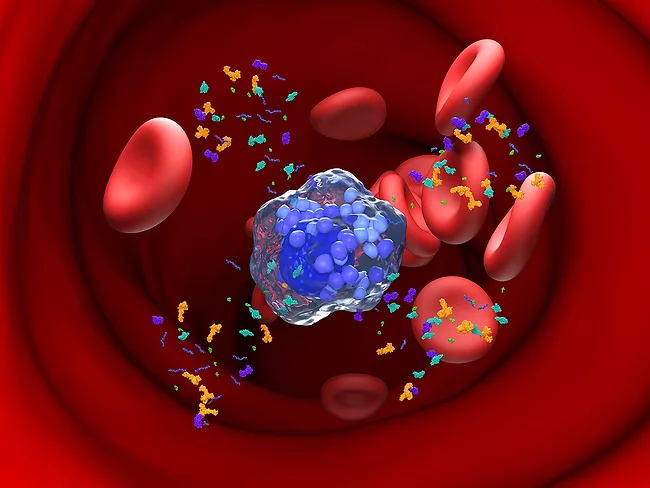
The variety of blood cells decreases with age. Some are lost, while others become dominant, leading to a loss of functional diversity. This, in turn, weakens the immune system in older individuals and increases the risk of developing hematological diseases. Scientists in Barcelona have developed a method based on DNA methylation that works like a barcode. EPI-Clone identifies and traces the origin of blood cells to measure the complexity of these clones in aging humans and mice.
An international group of scientists has completed the first draft of The Pan-Cancer Proteome Atlas (TPCPA). The project is based on mass spectrometry of 22 cancer types, which has identified more than 9,000 proteins from 1,000 tumors. The results reveal which proteins allow for the classification of different cancer types, biomarkers and potential therapeutic targets, which are now available to the entire scientific community.
A peptide with a dual mechanism of action – it dissolves the bacterial membrane and activates the immune system – could be an effective weapon against microorganisms that have evolved ways to evade antibiotics, as superbugs do. Scientists at the University of Pennsylvania (UPenn) have designed stable synthetic peptides that activate mast cell receptors, which are cells involved in the innate and adaptive immune response. This dual approach eliminates bacteria and recruits neutrophils to finish the job.
The variety of blood cells decreases with age. Some are lost, while others become dominant, leading to a loss of functional diversity. This, in turn, weakens the immune system in older individuals and increases the risk of developing hematological diseases. Scientists in Barcelona have developed a method based on DNA methylation that works like a barcode. EPI-Clone identifies and traces the origin of blood cells to measure the complexity of these clones in aging humans and mice.
The lack of animal models that mimic human disease impedes the study of many pathologies that still lack treatment beyond symptom relief. This is what has happened so far with PURA syndrome, a rare disorder affecting brain development for which a mouse model has finally been developed. Other times, small and large models exist, but an effective treatment remains elusive, as is the case with Krabbe disease, a fatal disease in children that could be prevented with the advances in gene therapy.
A collaboration of scientists from the NIH Brain Initiative consortium has published eight simultaneous studies in Neuron, Cell, Cell Genomics, Cell Reports and Cell Reports Methods, with the results of the Armamentarium project, a new set of gene therapy tools for the research and treatment of human brain disorders. The methodology, based on genetic techniques, RNA detection, genomic enhancers and viral vectors, is designed to access different CNS cell types, neuronal and non-neuronal cells, with common and reproducible protocols now available for any laboratory.
Since the development of the base and prime editing technique by David Liu at the Broad Institute, their applications in biomedicine have continued to grow, reaching 17 clinical trials for base editing and one clinical assay for prime editing. The 28th Annual Meeting of the American Society of Gene & Cell Therapy (ASGCT) marked a historic milestone this year by presenting the first case of treatment with base editors of a baby with a deadly metabolic disease.
Gene and cell therapies (GCTs) can target the kidney to treat congenital, acute or chronic diseases affecting this organ. However, its complex structure poses a challenge for these technologies. To be precise and effective in the long term, new approaches should circumvent the specificities of renal tissue, with novel methods of delivery and gene transfer to offer new therapeutic options for patients who lack them.
Metabolic disorders such as argininosuccinic and glutaric aciduria, methylmalonic acidemia, homocystinuria or primary hyperoxaluria require specific diets to prevent the accumulation of substances that the body can’t process. Current treatments mainly focus on managing symptoms and metabolite levels, and do not always prevent the progressive deterioration caused by mutations associated with the condition. However, emerging gene therapies hold promise for transforming these diseases by targeting their underlying causes, as presented in the oral abstract session, “Gene and cell therapy for metabolic diseases” of the ongoing 28th Annual Meeting of the American Society of Gene & Cell Therapy (ASGCT) meeting in New Orleans.
Scientists at the Center for Genomic Regulation (CRG) have developed an AI-based tool to design thousands of sequences that regulate DNA. They have also synthesized these molecules, called enhancers, to control gene activation in mouse hematopoietic stem cells, which they have tested in vitro.