Abbott Laboratories reported results from its PERSIST-END study demonstrating that close to nine in 10 patients treated for persistent atrial fibrillation (AF) with its Tacticath contact force ablation, sensor-enabled (Tacticath SE) were free of symptoms of their arrhythmia over 15 months of follow-up. The study’s findings, which supported a November 2021 FDA approval for persistent AF, also showed significant improvement in patients’ quality of life and a more than 50% cut in the use of health care resources, the company said.
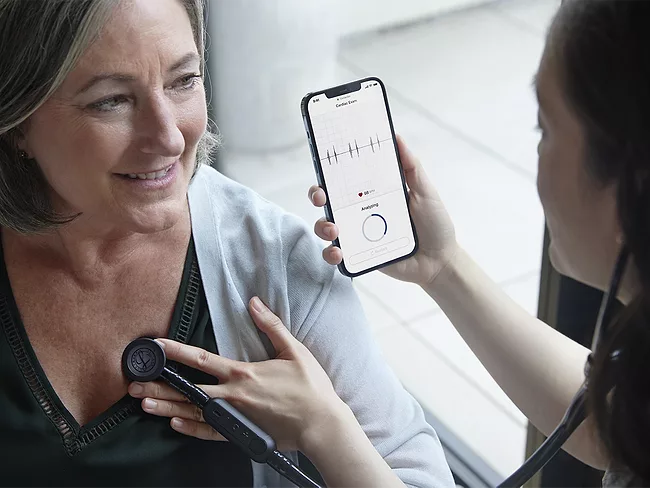
Eko Devices Inc. launched a redesigned app and smart stethoscope system to detect heart disease during a regular physical, potentially reducing the time to diagnosis and treatment for America’s number one killer. The system incorporates artificial intelligence (AI) to identify heart murmurs and atrial fibrillation with performance the company says is on par with cardiologists.
For about one-third of stroke patients, the cause of their cerebrovascular accident (CVA) is unknown at the time of hospitalization, but crucial to determine to prevent subsequent strokes. Electrocardiogram (ECG) monitoring in the 24 to 48 hours after a stroke detects atrial fibrillation (AF) in about 5% of patients. Remote monitoring with a noninvasive device detects far more cases and provides the opportunity to quickly head off secondary strokes, preserving lives and reducing costs of care, according to a study published by Royal Philips NV researchers.
Several recent studies highlight the rapidly expanding applications for neuromodulation using bioelectronic devices. A pair of articles in the Journal of the American Heart Association and Journal of the American College of Cardiology focused on the benefits to patients with heart failure and those at risk of post-operative atrial fibrillation, respectively. A study published in Brain Stimulation found that 85% of tinnitus patients experienced resolution of their symptoms when using a neuromodulation device.
Abbott Laboratories reported the commencement of a pivotal clinical trial for its Aveir pacemaker in a two-device configuration to provide dual-chamber pacing without the need for leads to deliver the charge. This configuration required the development of i2i technology to ensure that the two Aveirs communicated in a manner that ensures consistent pacing, but the 500-enrollee study has a long road ahead of it before the company can finalize the application with the FDA.
The U.S. Preventive Services Task Force (USPSTF) has once again broached the question of whether screening for atrial fibrillation (AF) in asymptomatic patients is a worthwhile exercise in public health, and once again the answer is “we don’t know.”
Acutus Medical Inc. provided highlights of a corporate restructuring along with preliminary unaudited revenues for the fourth quarter and year ended Dec. 31, 2021. The company “will prioritize maximizing console utilization and procedure volume growth in targeted geographic regions as well as a more focused scope of product development initiatives.” The restructuring will include the layoff of more than 50 staff members and reduction of manufacturing costs designed to produce annualized operating expense savings of $23 million to $25 million in 2022.
Medtronic plc continued its aggressive acquisition strategy today with the announcement of an agreement to purchase Affera Inc. Medtronic Chairman and CEO Geoff Martha revealed in a presentation on Jan. 10 at the virtual edition of the J.P. Morgan Healthcare Conference that his company was paying $925 million for the cardiac mapping and navigation company. The total reflects $250 million in payments assuming Affera meets “contingent considerations.”
The U.K. National Institute for Health and Care Excellence (NICE) has recommended the use of the Kardiamobile as an option for detecting atrial fibrillation (AF) events in patients diagnosed with suspected paroxysmal AF. Alivecor Inc., of Mountain View, Calif., is the obvious beneficiary of the recommendation, a good bit of news given the company’s struggles to maintain patent protection for its products.
The FDA granted Cardialen Inc. an investigational device exemption (IDE) to begin a clinical trial of its Multipulse Therapy (MPT) to treat paroxysmal and persistent atrial fibrillation (AF). MPT is a low-energy electrical pulse therapy aimed at restoring abnormally rapid heart rates, such as AF, to a regular rhythm to reduce the potential for high-energy shocks. Studies have shown that almost 1 in 4 patients experience anxiety or depression after receiving an implantable cardioverter defibrillator (ICD).