With the $2 trillion Build Back Better spending bill held up in the U.S. Senate, President Joe Biden took to his public microphone Dec. 6 to call on senators to pass the bill that will permit Medicare negotiation of certain prescription drug prices, impose an excise tax on drug companies that raise the price of their products beyond inflation and set a monthly cap on cost-sharing for insulin.
Pharmaceutical companies in China will cut the prices for more than five dozen drugs by an average of 61.7% to get them on the latest version of the country’s National Drug Reimbursement List. The National Healthcare Security Administration released the new list on Dec. 3, 2021. The new list includes 74 new drugs, the vast majority of which are branded products without generic versions in China. Only seven of the new drugs on the list have generic versions.
The U.S. Court of Appeals for the Federal Circuit struck a blow Nov. 30 to Biogen Inc.’s blockbuster multiple sclerosis (MS) drug, Tecfidera, affirming a lower court’s determination that a patent claiming a method of treating MS was invalid for lack of written description. In two other precedential cases the next day, the appellate court opened the door for Arbutus Biopharma Corp. to seek royalties on Moderna Inc.’s COVID-19 vaccine.
A European approval for Alzheimer’s drug aducanumab by year-end looks even more in doubt. A week after being called in before the EMA’s Committee for Medicinal Products for Human Use (CHMP) for an oral explanation of the trial data, Biogen Inc. said it received a “negative trend vote” on the marketing authorization application. A formal opinion by the CHMP is expected at its December meeting, but analysts are not optimistic.
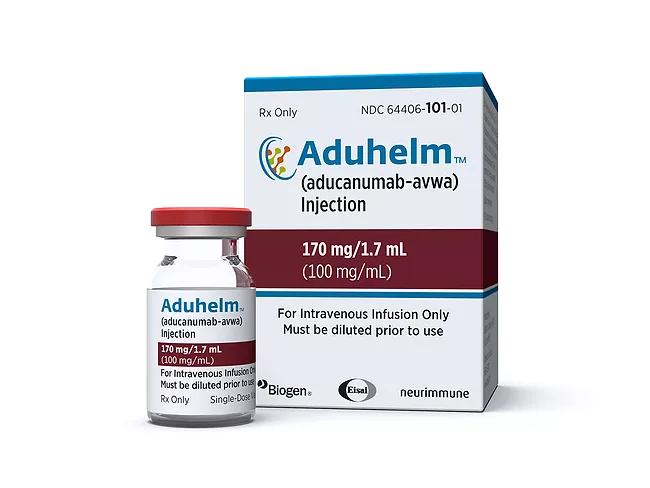
Technically speaking, the scientific community as a whole cannot say for sure whether and how well Aduhelm (aducanumab, Biogen Inc./Eisai, Co., Ltd.) works. After all, two years after the initial report of the Engage and Emerge data at the 2019 Clinical Trials in Alzheimer’s Disease (CTAD), the full trial data have still not been published in a peer-reviewed publication. Which, of course, is one of the problems with Aduhelm.
European regulators have put off a decision on Biogen Inc and Eisai, Co. Ltd.’s controversial Alzheimer’s drug, aducanumab, for likely another month, after the companies announced further supportive data from a follow-up under review by the FDA.
As part of its pharmacovigilance program for Alzheimer’s drug Aduhelm (aducanumab), Biogen Inc. is evaluating a handful of reports published in the FDA Adverse Event Reporting System Public Dashboard, including the Aug. 18 death of a 75-year-old woman with Alzheimer’s and other co-morbidities.
Biogen Inc.’s phase III trial of tofersen in a form amyotrophic lateral sclerosis (ALS) has missed its main goal, but the company said it is still talking with regulators after seeing positive trends in the data.
Biogen Inc. opened the 37th Congress of the European Committee for Treatment and Research in Multiple Sclerosis (ECTRIMS) virtual meeting with data showing those treated with its multiple sclerosis (MS) therapies had an effective antibody response to COVID-19 vaccination.
Just months after the controversial FDA approval of Alzheimer’s disease drug Aduhelm (aducanumab), partners on that medicine, Eisai Co. Ltd. and Biogen Inc., are advancing a BLA for another possible AD therapy, lecanemab. Formerly known as BAN-2401, the Bioarctic AB-originated antibody is designed to neutralize and eliminate soluble, toxic amyloid beta for the treatment of early AD. The rolling submission, in pursuit of an accelerated approval, was primarily based on data from a phase IIb trial in people with early AD and confirmed amyloid pathology.