Disco Pharmaceuticals GmbH announced the final close of its seed round at €36 million (US$42 million), as it shapes up novel targets it has discovered with its surfaceome platform technology for formal preclinical development.
Disco Pharmaceuticals GmbH announced the final close of its seed round at €36 million (US$42 million), as it shapes up novel targets it has discovered with its surfaceome platform technology for formal preclinical development.
Nuage Therapeutics SL has secured €2.7 million (US$3.1 million) in funding from the Spanish State Research Agency (AEI) of the Ministry of Science, Innovation and Universities that will support a research project focused on developing a new drug against the most common subtype of small-cell lung cancer (SCLC-A), in collaboration with the Spanish National Cancer Research Centre (CNIO), the European Molecular Biology Laboratory (EMBL), and the Vall d’Hebron Institute of Oncology (VHIO).
CIS Biopharma AG recently presented an antibody-drug conjugate (ADC) targeting the L1 cell adhesion molecule (L1CAM/CD171) as a potential candidate for the treatment of advanced tumors.
Changchung Genescience Pharmaceutical Co. Ltd., reported effects of the bispecific antibody-drug conjugate (ADC) of Gensci-143, is in metastatic castration-resistant prostate cancer (mCRPC) and other solid tumors.
At the AACR-NCI-EORTC International Conference on Molecular Targets and Cancer Therapeutics, Frontier Medicines Corp. presented a first-in-class covalent activator of p53 Y220C with high potency and selectivity in restoring p53 tumor suppressor function.
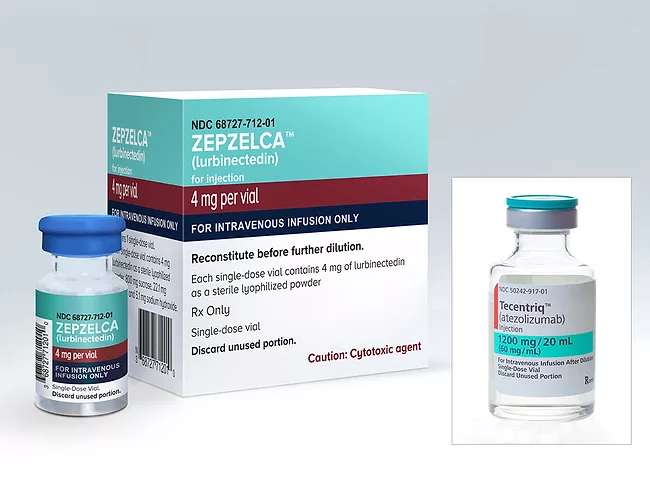
The U.S. FDA has approved the priority sNDA for a new first-line maintenance therapy in extensive-stage small-cell lung cancer from Jazz Pharmaceuticals plc. Zepzelca (lurbinectedin) can now be combined with Tecentriq (atezolizumab, Roche AG) or atezolizumab and hyaluronidase-tqjs (Tecentriq Hybreza, Roche) as a maintenance therapy for adults who haven’t progressed after first-line induction therapy with atezolizumab, carboplatin and etoposide.
Two back-to-back papers published in Nature on Sept. 10, 2025, shed new light on the unexpected role of neurons in shaping the evolution of small-cell lung cancer (SCLC). It’s already known that, in gliomas, cerebral cancer cells actively damage axons, contributing to tumor progression through direct neural disruption.
Two back-to-back papers published in Nature on Sept. 10, 2025, shed new light on the unexpected role of neurons in shaping the evolution of small-cell lung cancer (SCLC). It’s already known that, in gliomas, cerebral cancer cells actively damage axons, contributing to tumor progression through direct neural disruption. Comparable nerve-tumor interactions have been reported in peripheral cancers, where tumor-induced nerve disruption promotes inflammation and an immunosuppressive microenvironment linked to immunotherapy resistance.
Positive phase I results in small-cell lung cancer (SCLC) from Ideaya Biosciences Inc. and partner Hengrui Pharmaceuticals Co. Ltd. with IDE-849, a potentially first-in-class antibody-drug conjugate targeting delta-like ligand 3 (DLL3) and topoisomerase 1, sharpened interest in the DLL3 mechanism, which gave Zai Lab Ltd. a phase Ia/Ib win this year in extensive-stage (ES) SCLC.