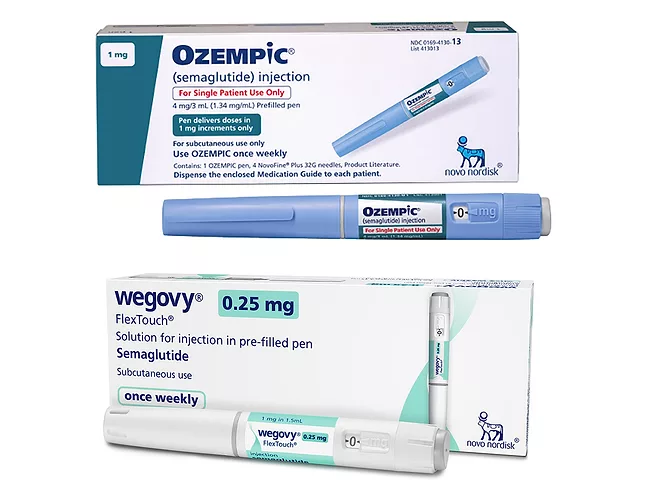
The European Commission approved Novo Holding A/S’ acquisition of Catalent Inc., a global contract development and manufacturing organization expected to help Novo Nordisk A/S keep up with increasing demand for its GLP-1 drug, Wegovy (semaglutide).
Although head-to-head results on tolerability were missing from the company’s data release, Eli Lilly and Co. said its U.S. FDA-approved weight-loss drug Zepbound (tirzepatide) beat the also-cleared Novo Nordic A/S compound Wegovy (semaglutide) in a phase IIIb study comparing the two.
When U.S. CMS Administrator Chiquita Brooks-LaSure announced Nov. 26 that the agency is “reinterpreting” the law in proposing a rule allowing Medicare and Medicaid to cover obesity drugs beginning in 2026, she called it a “historic step.” The rule, if finalized, could make obesity drugs like Novo Nordisk A/S’ Wegovy (semaglutide) and Eli Lilly and Co.’s Zepbound (tirzepatide) available to millions more Americans and further invigorate development of other obesity drugs. But given the lateness of the day in the Biden administration, the proposal may be more symbolic than historic.
Nearly $3.8 billion was earned by Novo Nordisk A/S and Eli Lilly and Co. in the third quarter for their glucagon-like peptide-1 (GLP-1) drugs to treat obesity. Novo’s GLP-1 drug, Wegovy (semaglutide), approved by the U.S. FDA in June 2021, had sales of DKK17.3 billion (US$2.5 billion), while Lilly’s Zepbound (tirzepatide), which is a GLP-1 and glucose-dependent insulinotropic polypeptide dual agonist FDA-approved in November 2023, posted sales of $1.26 billion for the quarter.
Danish pharma giant Novo Nordisk A/S is set to launch its blockbuster glucagon-like peptide-1 therapy, Wegovy (semaglutide), in South Korea’s growing obesity therapeutics market next week, a company official confirmed to BioWorld.
Neurobo Pharmaceuticals Inc., of Cambridge, Mass., reported top-line phase Ia study results of its obesity drug candidate, DA-1726, Sept. 30, causing the company’s shares to lose 11.7% of their value over two days.
Given the demand for Ozempic and Wegovy and the revenue the GLP-1 drugs are generating for Novo Nordisk A/S in the U.S., a lot of generic companies are clamoring to cash in on the drugs’ current popularity. And there are some U.S. lawmakers more than willing to oblige.
While in the hot seat at a Sept. 24 U.S. Senate Health, Education, Labor and Pensions (HELP) Committee hearing, Novo Nordisk A/S President and CEO Lars Fruergaard Jørgensen said he would sit down with Sen. Bernie Sanders (I-Vt.) and the three largest pharmacy benefit managers to discuss lowering the list prices for the company’s popular diabetes and weight-loss drugs, Ozempic and Wegovy.
Two leading glucagon-like peptide-1 (GLP-1) receptor agonists for obesity and type 2 diabetes – Novo Nordisk A/S’s semaglutide (Wegovy/Ozempic) and Eli Lilly and Co.’s tirzepatide (Mounjaro/Zepbound) – are advancing in China after taking the U.S. market by storm.
Chinese pharmaceutical and biotech companies are leading development of glucagon-like peptide-1 receptor agonists as Novo Nordisk A/S and Eli Lilly and Co. edge closer to launching blockbuster therapies in China. At the heart of the GLP-1 boom is a nationwide obesity problem driven by a confluence of factors, including the rise of a modern, sedentary lifestyle, according to Clarivate. Despite the rising prevalence of obesity and type 2 diabetes, the gap in obesity therapeutics is “substantial and leaves a solid market opportunity for weight loss drugs,” Karan Verma, principal analyst of healthcare research & data analytics at Clarivate, said.