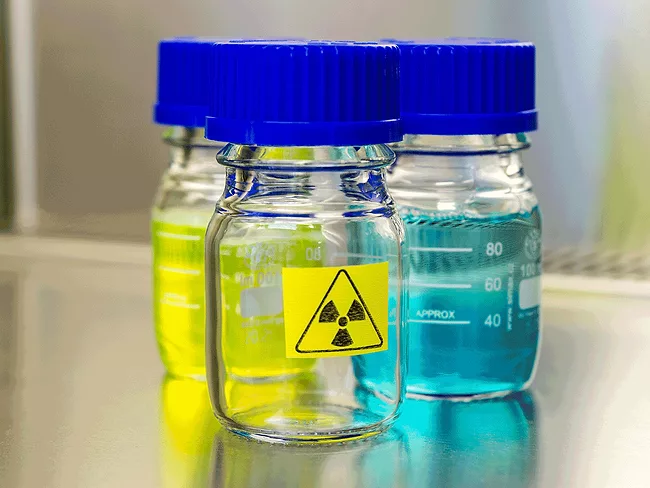
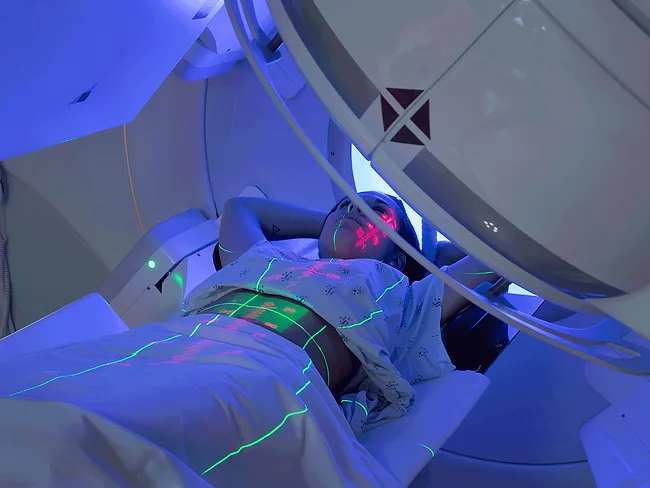
The radiopharma field has garnered increasing attention in recent years due to big-ticket deals like Bayer AG's $2.9 billion acquisition of Algeta ASA and Novartis AG's nearly $6 billion spent on buying Advanced Accelerator Applications SA and Endocyte Inc. As a result, competition is ratcheting up and pipelines are exploding with new combinations of different drugs. The global radiopharmaceuticals market was estimated to be valued at $6.7 billion in 2020, a number expected to reach $11.5 billion by 2027, according to a 2022 William Blair report.
Global interest in radiopharmaceuticals is growing, and some big deals in the space have sparked interest in the last few years. Novartis AG has spent about $6 billion in acquisitions and is seen as the global leader.
The big idea behind radiopharmaceuticals is taking the hallmarks of two cancer therapies – radiology and chemotherapy – and merging them, and this is what makes the technology a disrupter.
After spending decades developing targeted chemotherapy and bringing a dozen or so compounds into the clinic, Fusion Pharmaceuticals Inc. Chief Scientific Officer Christopher Leamon switched careers to focus on radio-oncology because he saw the need for “a really strong bomb to target cancer to get it to respond.” That was radiotherapy, said Leamon, who was one of the scientific founders of Endocyte Inc., which Novartis AG acquired.
Global interest in radiopharmaceuticals is growing, and some big deals in the space have sparked interest in the last few years. Novartis AG has spent about $6 billion in acquisitions and is seen as the global leader.
The big idea behind radiopharmaceuticals is taking the hallmarks of two cancer therapies – radiology and chemotherapy – and merging them, and this is what makes the technology a disrupter.
U.S. lawmakers have been busy writing to government agencies demanding answers and explanations on a range of issues, including drug shortages, gain-of-function research and thickets of duplicative patents that extend patent protection well beyond 20 years for some prescription drugs.
After Novartis AG decided not to take it forward in-house, the U.S. National Institute on Drug Abuse is to fund phase III development of mavoglurant in the treatment of cocaine abuse disorder. The agreement to back a trial involving up to 330 participants is with Stalicla SA, which in-licensed the glutamate receptor antagonist from Novartis earlier this year.
Are deals such as M&As between biotechs and big pharma becoming a thing of the past? That was a key question posed during the opening keynote at this year’s BIO-Europe Spring conference in Basel, Switzerland. Although Susanne Kreutz, global head of corporate and business development of Basel-based Novartis AG, doesn’t think this is the case, she told delegates that she believes M&A will increasingly focus in on “high-quality, high-impact, late-stage assets, where reimbursement is securable and where regulatory paths appear.”