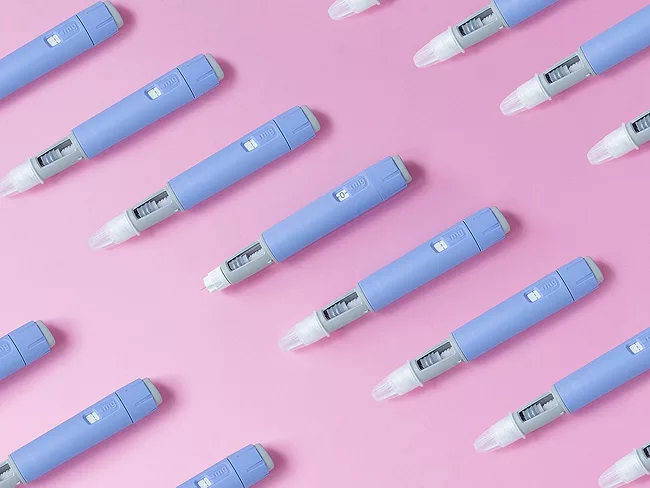
Chinese pharmaceutical and biotech companies are leading development of glucagon-like peptide-1 receptor agonists as Novo Nordisk A/S and Eli Lilly and Co. edge closer to launching blockbuster therapies in China. At the heart of the GLP-1 boom is a nationwide obesity problem driven by a confluence of factors, including the rise of a modern, sedentary lifestyle, according to Clarivate. Despite the rising prevalence of obesity and type 2 diabetes, the gap in obesity therapeutics is “substantial and leaves a solid market opportunity for weight loss drugs,” Karan Verma, principal analyst of healthcare research & data analytics at Clarivate, said.
Novo Nordisk A/S has exercised an option to license a ligand identified by Kallyope Inc. for further development, including as a potential new approach for the treatment of obesity.
Two leading glucagon-like peptide-1 (GLP-1) receptor agonists for obesity and type 2 diabetes – Novo Nordisk A/S’s semaglutide (Wegovy/Ozempic) and Eli Lilly and Co.’s tirzepatide (Mounjaro/Zepbound) – are advancing in China after taking the U.S. market by storm. China represents the world’s largest population of diabetes and obesity patients. Its GLP-1 market, valued at about $1.7 billion in 2023 according to Clarivate, is expected to grow as the number of obesity patients is projected to exceed 500 million by 2033.
With Novo Nordisk A/S hobbled by a complete response letter, Eli Lilly and Co. has forged ahead in developing a once-weekly type 2 diabetes treatment. Top-line data from Lilly’s phase III Qwint-1 and Qwint-3 studies of efsitora alfa showed noninferior average levels of blood glucose, A1C, compared to those using another daily basal insulin treatment.
In the wake of shortages for Novo Nordisk A/S’ Ozempic (semaglutide), Australia’s Therapeutic Goods Administration has announced that Wegovy, which has the same active ingredient, is now available in Australia and is advising prescribers to stop prescribing Ozempic off-label for weight loss.
In the wake of shortages for Novo Nordisk A/S’ Ozempic (semaglutide), Australia’s Therapeutic Goods Administration has announced that Wegovy, which has the same active ingredient, is now available in Australia and is advising prescribers to stop prescribing Ozempic off-label for weight loss.
Novo Nordisk A/S presented a mixed bag of R&D results for its cardiometabolic assets in the first half of 2024 as it axed three drug candidates but advanced one to a late-stage study. In the search for greener pastures beyond a crowding obesity market, Novo announced Aug. 7 that it advanced ziltivekimab into a phase III study to assess the subcutaneous therapy’s cardiovascular outcomes in acute myocardial infarction patients.
The U.S. Department of Health and Human Services (HHS) is 6-1 so far in blocking court challenges to the Medicare price negotiation program mandated by the Inflation Reduction Act (IRA). The department’s latest victory came July 31 when a federal district judge in New Jersey tossed a complaint filed by Novo Nordisk A/S, citing a lack of jurisdiction on the court’s part and the company’s lack of standing.
Viking Therapeutics Inc. is diving more deeply into developing obesity treatments and investors like an accelerated timetable the company has proposed. On June 25, Viking shares (NASDAQ:VKTX) catapulted 28.3% upward to close at $64.68 each.
Just a day after the U.S. FTC released an interim report on harmful pharmacy benefit manager (PBM) practices and appeared before a House subcommittee that encouraged the commissioners to take enforcement action, the agency reportedly was preparing to file suit against the country’s three largest PBMs over their practices in negotiating insulin and other drug prices.