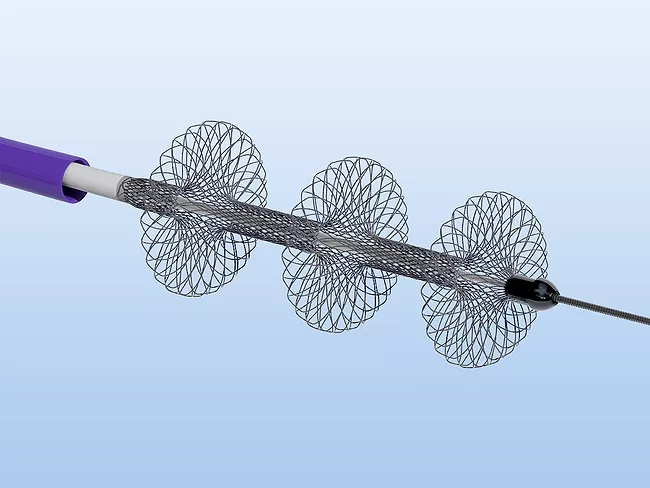
Premarket approval by the U.S. FDA of a new venous stent system made by Medtronic plc could blast through impediments for patients who suffer from complex deep vein obstruction. Less than 1% of patients with iliofemoral venous outflow obstruction currently receive treatment, despite the risk of serious complications and sharply reduced quality of life. Approval of the Abre stent was based on a 200-patient clinical study.
The U.S. FDA draft guidance for select updates for premarket evaluation of class II atherectomy devices arrived with a lack of clarity that prompted device makers and clinicians alike to request the FDA address several sources of ambiguity. One of these is whether the agency should distinguish between particulate matter from the device vs. calcium particulates from the treated artery, while another is whether particulate evaluation is required only for devices with a coating.
Abiomed Inc. has won the U.S. FDA’s nod for its Breethe Oxy-1 device, an all-in-one, compact cardiopulmonary bypass system designed for easy mobility. The company plans a controlled release at U.S. hospitals between now and March of 2021, with widespread availability later that year.
Keeping you up to date on recent developments in cardiology, including: Monitoring the hearts of breast cancer patients; Cardiamp demonstrates improvement in heart failure patients; Weight-reduction surgery in severely obese patients could ward off second heart attack.
Edwards Lifesciences Corp. reported good news this week, with its third-quarter results exceeding expectations. Sales came in at $1.1 billion, an increase of 4%, and CEO Mike Mussallem highlighted the success of transcatheter aortic valve replacement (TAVR), with the Sapien valve platform performing well. Mussallem noted that TAVR sales were $745 million, up 6%, with Europe showing strength.
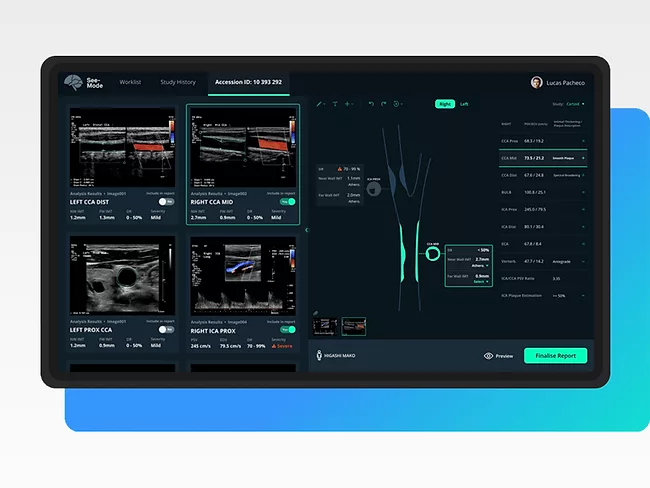
PERTH, Australia – See-Mode Technologies has received 510(k) clearance from the U.S. FDA to market its Augmented Vascular Analysis (AVA) program that uses artificial intelligence (AI) to analyze vascular ultrasound scans to better predict stroke. Caused by plaque that ruptures in blood vessels and blocks blood flow to the brain, stroke affects roughly 15 million people per year and is the second-leading cause of death globally.
Royal Philips NV is launching its Quickclear mechanical thrombectomy system in the U.S. four months after obtaining FDA clearance. “Quickclear's intuitive design simplifies the entire thrombectomy procedure work flow. Our new medical device can help bring cost-effective solutions in both the hospital and outpatient care settings,” Chris Landon, senior vice president & business leader, image guided therapy devices at Philips, told BioWorld.
Inari Medical Inc.'s Flowtriever device appears to offer a safer and more effective option for pulmonary embolisms than current treatment with thrombolytics or open embolectomy, according to prospective study presented at the TCT Connect 2020 conference.
Medtronic plc reported promising results from a feasibility study of its In.Pact 0.014 drug-coated balloon (DCB) in critical limb ischemia (ICL) patients with chronic total occlusion (CTO) in the infrapopliteal arteries.
Keeping you up to date on recent developments in cardiology, including: Biobeat's wearable monitoring device shows promise in swine model; Neutrophils are literal obstacle to stroke recovery; Neovessel formation eyed in treating cardiovascular diseases.
 RSS
RSS