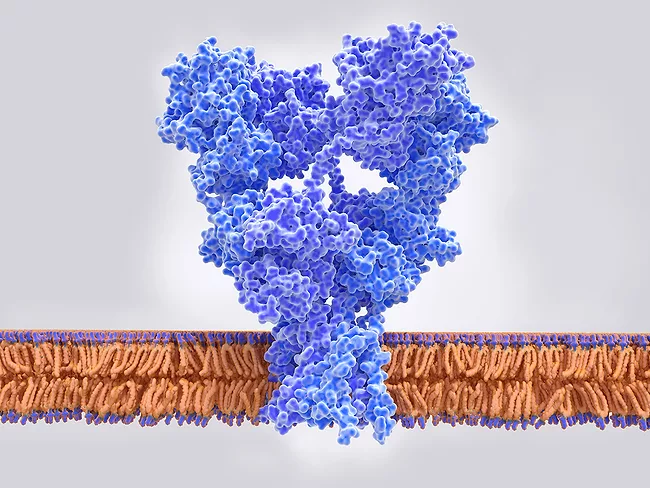
Researchers have discovered that a subunit of the ubiquitin-proteasome system acted independently of the proteasome machinery to regulate AMPA receptors, a type of glutamate receptor, at multiple steps of their life cycle. Published in the May 26, 2023, issue of Science, the findings could point to ways to target AMPA receptors. They are responsible for the majority of excitatory transmission in the central nervous system, and current drugs seeking to influence AMPA-based transmission are “good but they are not great,” Erin Schuman told BioWorld. “This regulatory particle is watching the glutamate receptor at each step.” Schuman is the director of the Max Planck Institute for Brain Research and the paper’s senior author.
Medshine Discovery Inc. has divulged azaspiro compounds acting as leucine-rich repeat kinase 2 (LRRK2; dardarin) inhibitors reported to be useful for the treatment of Parkinson’s disease.
Amplo Biotechnology Inc. has been awarded a fast track phase I/II Small Business Technology Transfer (STTR) grant from the National Institute of Arthritis and Musculoskeletal and Skin Diseases (NIAMS) of the National Institutes of Health (NIH) to fund further development of AMP-201, an AAV-ColQ gene therapy designed to address congenital myasthenic syndrome caused by collagen Q (ColQ) deficiency.
With overuse of opioids – the standard of care for many chronic pain cases – becoming something of an epidemic in the U.S., the availability of an alternative, non-opioid analgesic is a big draw. Established in 2021, Adolore Biotherapeutics Inc. is one company that could provide the answer, with its locally and long-acting gene therapies potentially providing a breakthrough that “knocks everybody’s socks off.”
Researchers from Huidagene Therapeutics Co. Ltd. have evaluated the effects of adenine base editing (ABE)-induced exon skipping of exon 50 in a humanized mouse model of Duchenne muscular dystrophy (DMD).
Neuronal ceroid lipofuscinosis, commonly known as Batten disease, is an inherited pediatric neurodegenerative lysosomal storage disease caused by mutations in the CLN5 gene. The disease is incurable and there is an urgent medical need for novel therapies. A murine model of Batten disease was developed to study a novel AAV vector that expresses CLN5, AAV9-CLN5. In the study by University College London investigators, the gene therapy, driven by the synapsin promoter, was intracerebroventricularly administered into neonatal Cln5-knockout mice.
 RSS
RSS