The latest global regulatory news, changes and updates affecting medical devices and technologies, including: Nuclear Regulatory Commission issues advisory letter to INIS; HHS authorizes pharmacy interns to test for COVID-19.
Drug and medical device manufacturers have several compliance matters to deal with under the False Claims Act (FCA), only one of which is the Anti-Kickback Statute (AKS). Nonetheless, the AKS might be a good area for members of industry to emphasize, given that it accounted for the vast majority of federal enforcement actions in fiscal year (FY) 2019, according to a new report by Gibson, Dunn & Crutcher LLP.
Patient engagement is increasingly the order of the day in the device development process as the U.S. FDA has made clear, a consideration that drove the Oct. 22 FDA advisory hearing. A patient representative said patients want to take part as early as possible in the development process for software as a medical device (SaMD), and Pat Baird, director of global software standards for Royal Pillips NV, said industry is very much open to ideas about bringing the patient perspective on board earlier in that process.
Regulatory snapshots, including global submissions and approvals, clinical trial approvals and other regulatory decisions and designations: Aidoc, Anika, Avioq, Cala Health, Embody.
The U.S. FDA’s recent decision to pass on any emergency use authorization (EUA) filings for tests for the COVID-19 pandemic is well known, but the agency had a chance to lend some additional information on that question in the Oct. 21 town hall. Despite the opportunity to clarify some of the underlying questions, Tim Stenzel, director of the Office of In Vitro Diagnostics and Radiological Health (OIR), said little more than that the change was made “largely because the FDA cannot require an EUA, according to the HHS statement.”
Digital medicine startup Appliedvr Inc. has gained breakthrough device designation status from the U.S. FDA for its virtual reality (VR) platform for treating treatment-resistant fibromyalgia and chronic intractable lower back pain. The designation follows the completion of a clinical trial assessing VR-based therapy for self-management of chronic pain at home.
While the FDA’s approach to evaluating safety and efficacy in the development and review of COVID-19 vaccines for the U.S. market will be at the center of its Oct. 22 advisory committee meeting, the panel also will be asked to discuss the practicalities, and ethics, of continuing to conduct trials once a candidate has been granted an emergency use authorization.
The latest global regulatory news, changes and updates affecting medical devices and technologies, including: Advamed says shipped tests reach 200M mark; Brazil, U.S. expand on 2011 trade handshake; Federal Circuit reaches split decision in review of IPR.
Regulatory snapshots, including global submissions and approvals, clinical trial approvals and other regulatory decisions and designations: Acuitive, Appliedvr, Certest, Tyber, Venturemed.
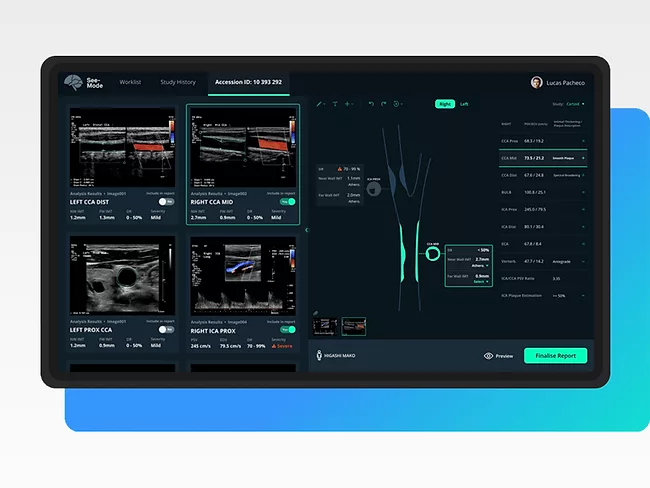
PERTH, Australia – See-Mode Technologies has received 510(k) clearance from the U.S. FDA to market its Augmented Vascular Analysis (AVA) program that uses artificial intelligence (AI) to analyze vascular ultrasound scans to better predict stroke. Caused by plaque that ruptures in blood vessels and blocks blood flow to the brain, stroke affects roughly 15 million people per year and is the second-leading cause of death globally.

 RSS
RSS