The U.S. FDA has announced a class I recall for the Wallstent Monorail system by Boston Scientific Corp. of Marlborough, Mass, a device for treatment of carotid artery stenosis. The company advised customers in early July to return any unused inventory because the inner diameter of the stent is narrower than intended, which may lead to difficulties in extracting the delivery device after placement of the stent.
The U.S. FDA has cleared Artrya Ltd.’s 510(k) for its Salix coronary plaque (SCP) module that is a bolt-on module to the company’s Salix coronary anatomy platform.
A group of stakeholders including medical device makers have penned a letter to Centers for Medicare & Medicaid Services administrator Mehmet Oz to urge the agency to cover breakthrough medical devices, an attempt to resurrect administrative action on a question that legislators failed to address in 2024.
Novocure GmbH said it submitted a premarket approval application to the U.S. FDA for its Optune Lua wearable device tumor treating fields therapy for the treatment of locally advanced pancreatic cancer.
The U.S. FDA released another series of regulations for de novo devices, but the attendant regulation is not always available for these de novo devices.
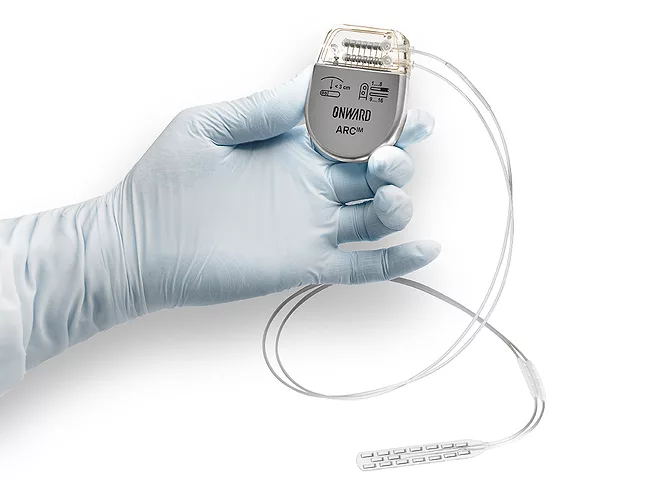
Onward Medical NV secured U.S. FDA investigational device exemption (IDE) approval for a pivotal study to assess the safety and efficacy of its implantable spinal stimulation technology, the ARC-IM system. The Empower study BP study will focus on addressing blood pressure instability in patients with spinal cord injury (SCI).
Neuroone Medical Technologies Corp. expanded into treatment of chronic pain with a new U.S. FDA clearance for use of its Onerf system to treat trigeminal nerve pain. The system uses radiofrequency ablation to disrupt pain signals from the nerve to the brain.
Deephealth Inc., a subsidiary of Radnet Inc., completed the acquisition of breast health solutions company Icad Inc. in a $110 million all-stock transaction. The company also received U.S. FDA 510(k) clearance for Techlive – a remote scanning solution enabling centralized operation and supervision of MR, CT, PET/CT and ultrasound procedures.
The FDA’s warning letter to Whoop Inc. resurrects questions about the agency’s observance of the 21st Century Cures Act in that the warning letter stakes out the position that any reading of blood pressure is “inherently associated” with hypertension.
 RSS
RSS