Due to the availability of drugs targeting histone acetylation and associated reader proteins, the equilibrium of histone acetylation and deacetylation has attracted attention in multiple myeloma as a potential therapeutic target. Therefore, the identification of novel predictive biomarkers for multiple myeloma patient selection for epigenetic therapies is urgently needed.
Arthrogryposis multiplex congenita (AMC) is a group of disorders defined by two or more contractures in different body areas; while genes encoding sarcomeric proteins are usually involved in its pathogenesis, the role of the dystrophin complex is not well studied in AMC. Utrophin, encoded by the UTRN gene, is an important fetal dystrophin homologue and was the focus of a recently presented study.
Autism spectrum disorder (ASD), developmental epileptic encephalopathies and other neurodevelopmental disorders are driven by the disruption of genes regulating neuronal proliferation, differentiation and synaptic maturation. Researchers from Shanghai Jiao Tong University School of Medicine generated Csnk2b haploinsufficient (Csnk2b+/-) mice mimicking the most relevant disease features to investigate the effects of reduced gene dosage.
More effective glucocorticoid-sparing therapies are needed for the treatment of giant cell arteritis (GCA). Studies found that complement signaling pathways involving complement factor 5 and its receptor (C5aR1) were overexpressed, and that a C5aR1 antagonist, avacopan, reduced the need for glucocorticoids and improved renal recovery. This led researchers to investigate the association of anti-C5aR1 antibodies with GCA and its outcomes.
CD45RC is an isoform of protein tyrosine phosphatase receptor type C, a protein that plays a key role in regulating antigen receptor signaling in T and B cells. While it is expressed on most circulating B cells, it is only highly expressed on Th1 precursors, Th1 cells and T effector memory CD45RA+ cells (TEMRA).
Researchers have identified a 14-protein blood signature that can predict lung cancer risk as much as five years before diagnosis, and the findings could help identify people who could benefit from preventive drugs. Published in Cell, the study was a collaboration between the Francis Crick Institute and University College London. It was co-led by Walter and Eliza Hall Institute laboratory head Clare Weeden, who conducted the research while at the Crick.
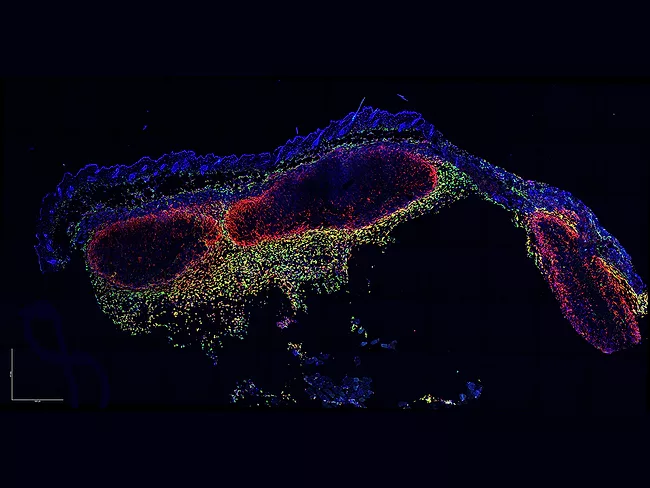
Australian researchers have identified a previously overlooked population of immune cells in the skin that physically restrain melanoma growth by engulfing live melanoma cells, and the discovery could reshape thinking around macrophage-targeted cancer therapies and innate immunity in oncology.
WAVES, an algorithm designed to extract menstrual-cycle metrics from physiological signals such as basal body temperature, which oscillates with sex hormones, shows how different parameters change with age and helps determine whether each person maintains a stable individual pattern or personal footprint. A study based on data from 5,674 cycles from 753 women demonstrates through this tool that age is associated with higher temperatures, shorter cycles, and greater irregularity. In addition, several metrics show within-person stability, suggesting they could serve as personalized health markers.
Small noncoding RNAs (sncRNAs), including miRNAs, piRNAs and snoRNAs, can provide further biological insights into the mechanisms of chronic kidney disease (CKD) in diabetes. Researchers from Leiden University Medical Center and collaborating institutions previously discovered that various classes of circulating sncRNAs are associated with kidney function (eGFR, uACR) and prevalent diabetic CKD.
 RSS
RSS