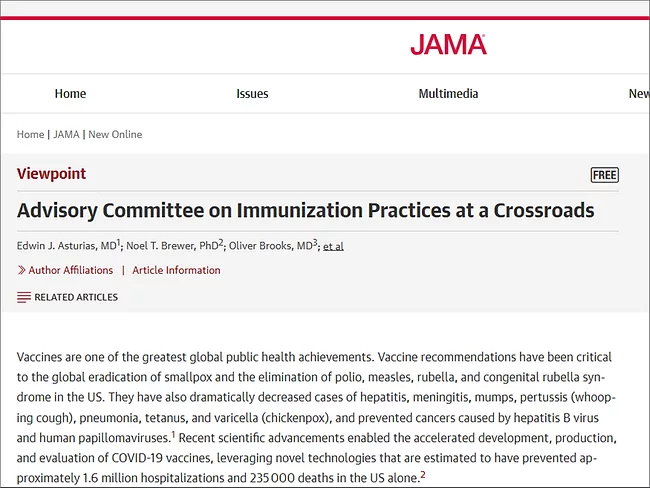
The 17 members abruptly terminated June 9 from the U.S. CDC’s Advisory Committee for Immunization Practices (ACIP) are not going gently into the night. Instead, they’re raging against what could be the dying of the light. The 17 raised their collective voices in a June 16 JAMA opinion piece to decry what’s at stake with Health and Human Services Secretary Robert Kennedy’s efforts, in his words, to “reestablish public confidence in vaccine science” by cleansing ACIP of what he claimed were conflicts due to members’ financial ties to industry.
Calling it “incredible news,” Massachusetts Attorney General Andrea Joy Campbell reported June 16 that U.S. District Judge William Young ordered the Trump administration to restore funding for NIH research grants focusing on gender and diversity, equity and inclusion (DEI).
The COVID-19 pandemic sent the world into a tailspin, raising ongoing concerns about biosecurity, a subject that encompassed the better part of the morning June 16, the first day of the Biotechnology Innovation Organization’s annual conference in Boston.
And then there were eight. That is, eight members of the U.S. CDC’s Advisory Committee for Immunization Practices (ACIP).Two days after dismissing the 17 members of the committee, Health and Human Services Secretary Robert Kennedy named eight new members to the panel. Eight is the minimum required for a quorum, which will be necessary for the June 25-27 ACIP meeting.
The bankruptcy of genetic testing service 23andme Holding Corp. prompted a reaction from many quarters, but a June 11 Senate hearing highlighted an interest in federal privacy legislation that would be directed toward genetic privacy as well as comprehensive and preemptive federal privacy legislation.
The bankruptcy of genetic testing service 23andme Holding Corp. prompted a reaction from many quarters, but a June 11 Senate hearing highlighted an interest in federal privacy legislation that would be directed toward genetic privacy as well as comprehensive and preemptive federal privacy legislation.
When it comes to the U.S. biopharma market, pricing seems to be the driving focus of most congressional conversations – and government contracts. Rep. Cliff Bentz, R-Ore., hit pause on that conversation at a June 11 House subcommittee hearing on the drug supply chain, when he asked if the U.S. is sacrificing security for price.
Despite the June 9 gutting of the U.S. CDC’s Advisory Committee for Immunization Practices, the Department of Health and Human Services said the committee’s June 25-27 meeting will continue as scheduled. But a new panel has yet to be named, and typically ACIP members have a lot of behind-the-scenes work to do before a meeting.
The Trump administration released its budget proposal for fiscal year 2026, which would chop roughly 40% from the NIH budget over the current fiscal year — a proposal that might not find much support on Capitol Hill.
The U.S. Department of Justice is reshuffling its enforcement focus for the coming three years per a May 12 memo attributed to Matthew Galeotti, director of the department’s criminal division. Galeotti said federal attorneys should avoid prosecutorial adventurism in an effort to strike what he described as “an appropriate balance” between enforcement and “unnecessary burdens on American enterprise.”
 RSS
RSS