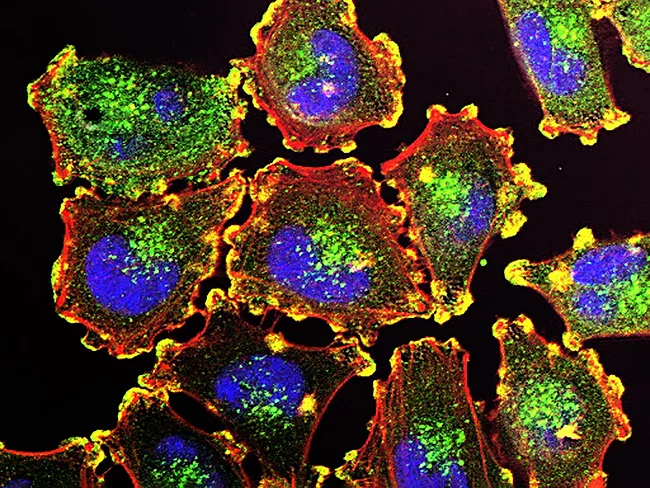
Immune checkpoint inhibitors (ICIs) have revolutionized the landscape of cancer management. However, acquired resistance and response variability point to rational combination strategies as the goal to achieve significant improvements in the field. Investigators at the National Cancer Center of Japan have found that stimulators of the innate immune response unexpectedly activated suppressive cells of the innate immune system.
Melanoma is the most aggressive form of skin cancer and often spreads to the brain. Though immunotherapy has greatly improved the outlook for even metastatic melanoma patients, once melanoma brain metastases (MBM) develop, prognosis worsens, and available therapeutic options decline. Scientists at the Institute for Neurosciences (IN), a joint center of the Spanish National Research Council (CSIC) and the Miguel Hernández University of Elche (UMH) have found a way to tackle MBM through microglial reprogramming.
According to the World Health Organization (WHO), multidrug-resistant pathogens caused over 1.27 million deaths worldwide in 2020. And figures are rising, with projections pointing to antimicrobial resistance surpassing cancer as the leading cause of death by 2050. Now, researchers at the HUN-REN Biological Research Center have unveiled the role of pre-existing genetic variabilities and specific cross-resistance patterns among several antibiotics designed to combat gram-positive bacteria.
According to the World Health Organization (WHO), multidrug-resistant pathogens caused over 1.27 million deaths worldwide in 2020. And figures are rising, with projections pointing to antimicrobial resistance surpassing cancer as the leading cause of death by 2050. Now, researchers at the HUN-REN Biological Research Center have unveiled the role of pre-existing genetic variabilities and specific cross-resistance patterns among several antibiotics designed to combat gram-positive bacteria.
Investigators at the Institute for Research in Biomedicine (IRB Barcelona) have unraveled how and why the absence of a neuronal microexon in cytoplasmic polyadenylation element-binding 4 (CPEB4) gives rise to autism. In 2018, investigators from IRB, co-led by Raúl Méndez, identified the overt correlation between defects in CPEB4 and the onset of autism. However, the previous work did not provide the molecular mechanism explaining the correlation.
Investigators at the Institute for Research in Biomedicine (IRB Barcelona) have unraveled how and why the absence of a neuronal microexon in cytoplasmic polyadenylation element-binding 4 (CPEB4) gives rise to autism. In 2018, investigators from IRB, co-led by Raúl Méndez, identified the overt correlation between defects in CPEB4 and the onset of autism. However, the previous work did not provide the molecular mechanism explaining the correlation.
Researchers from the University of California San Francisco (UCSF) have successfully replicated the design of regulatory T cells, achieving local targeted immune suppression and protection from CAR T-cell cytotoxicity. Many of the treatments used so far in the context of inflammatory and autoimmune disorders lead to systemic immunosuppression. In this sense, limiting immunosuppression locally to targeted tissues may help overcome systemic toxicity.
Researchers from Emory University, the U.S. CDC and collaborators have identified a broad-spectrum antiviral agent able to combat highly pathogenic arenaviruses. The compound, a ribonucleoside analogue that acts through RdRp inhibition, exhibited a good pharmacokinetic profile, oral bioavailability and tissue distribution in guinea pigs, while protecting animals from lethal challenges with Lassa and Junín viruses, even at very low doses.
Researchers from Emory University, the U.S. CDC and collaborators have identified a broad-spectrum antiviral agent able to combat highly pathogenic arenaviruses. The compound, a ribonucleoside analogue that acts through RdRp inhibition, exhibited a good pharmacokinetic profile, oral bioavailability and tissue distribution in guinea pigs, while protecting animals from lethal challenges with Lassa and Junín viruses, even at very low doses.
Researchers at Harvard Medical School have found that blocking the neuron-released peptide CGRP decreases pain sensitivity and reduces lesion size in endometriosis. Endometriosis is a painful, steroid-dependent inflammatory condition in which tissue similar to that of the endometrial lining grows and establishes outside the uterine mucosa.