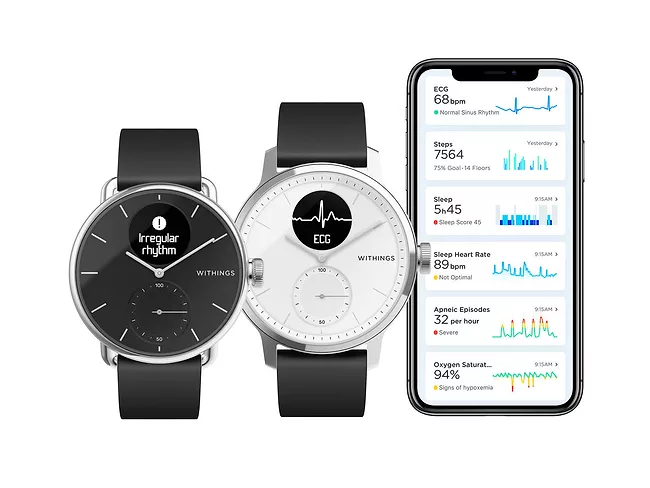
Issy-les-Moulineaux, France-based Withings SA said it’s planning to launch its latest product in the U.S. and Europe during the second quarter, the Scanwatch. It is expected to be the first smartwatch to offer both atrial fibrillation (AF) and sleep apnea detection; a CE mark and FDA clearance are both pending. Cardiac arrhythmia and sleep apnea are associated with one another and can be precursors to more serious health problems such as heart attack or stroke.
Vancouver, British Columbia-based Correvio Pharma Corp. is hoping that it will receive a positive response from the FDA’s Cardiovascular and Renal Drugs Advisory Committee, which meets tomorrow to consider the U.S. approvability of Brinavess (vernakalant hydrochloride, I.V.), its antiarrhythmic drug for the rapid conversion of adult patients with recent onset atrial fibrillation (AF).
Stanford University School of Medicine and Apple Inc.have published results from the largest digital-only study. The trial has been conducted in more than 400,000 people in the U.S. over more than eight months. It was set up to screen participants via their Apple Watch for heart irregularities and then to further monitor any of those with identified issues with a wearable ECG patch.
We who write about medical devices rarely suffer for content, but the month of May was unusually cooperative even by our standards. Following are two stories about medical devices that either emerged or resurfaced in the merry month of May, each of which involves a cardiologist and what some of us now think of as not-so-social media. Cabana and the case for catheter ablation We’ve all heard at least a little of the noise about catheter ablation for atrial fibrillation over the years, including assertions...
NEW ORLEANS – The Apple Heart study has accumulated data from more than 400,000 participants in its evaluation of the ability of an algorithm to detect abnormalities that may be indicative of atrial fibrillation (AF), although the enrollment came up short of the target of half a million users. Nonetheless, Mintu Turakhia, a cardiologist at Stanford, Calif.-based Stanford University, said that while the study has some significant limitations, "we now have a footprint for evaluating technology such as this, and how to do this in an appropriate and scalable way."