Casma Therapeutics Inc. has been awarded approximately $7.6 million in funding across two competitive grant programs from The Michael J. Fox Foundation for Parkinson’s Research (MJFF) to support Casma’s lead program, CSM-101.
Japan has approved the world’s first therapies derived from induced pluripotent stem cells (iPSCs), marking a major milestone for regenerative medicine and, potentially, a turning point in treating Parkinson’s disease.
Japan has approved the world’s first therapies derived from induced pluripotent stem cells (iPSCs), marking a major milestone for regenerative medicine and, potentially, a turning point in treating Parkinson’s disease.
Merck Sharp & Dohme LLC (MSD) has prepared and tested new positron emission tomography (PET) agents for binding and imaging α-synuclein (SNCA) for the diagnosis of Parkinson’s disease.
Porosome Therapeutics Inc. has announced the development of novel first-in-class porosome-targeting small molecules and blood-brain barrier-traversing peptide drugs developed using the company’s Porosome.AI platform to treat various secretory disorders, such as Alzheimer’s disease and type 2 diabetes.
Japan is backing conditional approvals of Amchepry (raguneprocel, Sumitomo Pharma Co. Ltd./Racthera Co. Ltd.) and Reheart (Cuorips Inc.), positioning them to become the world’s first induced pluripotent stem cell-derived (iPSC) therapies to receive regulatory clearance.
Japan is backing conditional approvals of Amchepry (raguneprocel, Sumitomo Pharma Co. Ltd./Racthera Co. Ltd.) and Reheart (Cuorips Inc.), positioning them to become the world’s first induced pluripotent stem cell-derived (iPSC) therapies to receive regulatory clearance.
Lario Therapeutics Ltd. has received a total of $2.4 million in grant funding from The Michael J. Fox Foundation for Parkinson’s Research (MJFF) and Wellcome to support the continued expansion of its neuronal calcium channel drug discovery platform. The funding provides validation of Lario’s work on selective small-molecule inhibitors of voltage-gated neuronal calcium channels.
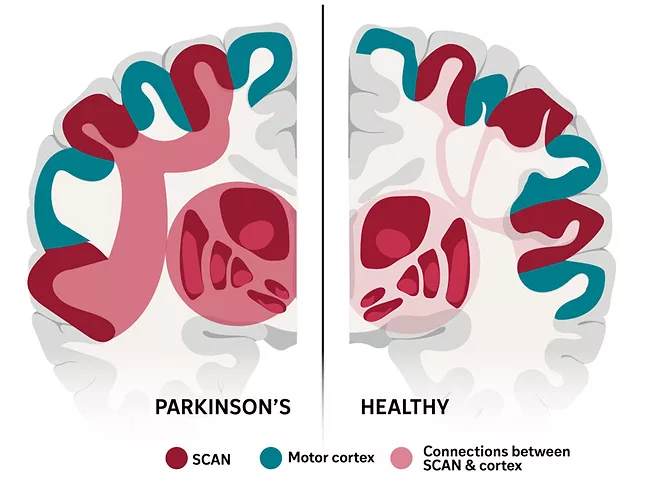
Parkinson’s disease is a neurodegenerative disorder that affects movement, and tremor is one of its signatures. But it is a much more wide-ranging disorder, and patients experience problems with cognitive and emotional processes as well. SCAN, the somato-cognitive action network identified in 2023, could reshape the definition of PD. Treating this circuit can improve outcomes.
Patients with Parkinson’s disease (PD) frequently suffer from sleep disorders, in addition to the neurodegenerative processes associated with the disease. These disorders affect both rapid eye movement (REM) and non-REM (NREM) sleep, but the underlying mechanisms in PD patients remain largely unknown.