Bluebird Bio Inc. has completed a rolling BLA filing of beta-thalassemia gene therapy beti-cel in the U.S., with analysts predicting that the Cambridge, Mass.-based biotech will have to shoot for a lower price tag after running into trouble with cost regulators in Europe.
Contrary to the broader markets, BioWorld’s Cancer Index is down by 22% this year, losing more than 7% throughout the month of July, despite oncology driving several high-money deals and accounting for 38%, the lion’s share, of financings. Both the Nasdaq Biotech Index and the Dow Jones Industrial Average are tracking similarly for the year, and are up by 13.2% and 15.2%, respectively, as of Aug. 10.
The new case of myelodysplastic syndrome (MDS) that overshadowed Bluebird Bio Inc.’s earnings and resulted in a clinical hold by the FDA will be addressed similarly to an earlier hitch in the sickle cell disease program, said Andrew Obenshain, the company’s head of severe genetic diseases. “Essentially, we will try and do the same thing,” and exonerate the lentiviral vector, he said during a conference call with investors. “At this point, we don't have tumor cells or leukemia to analyze,” he noted.
The FDA has lifted clinical holds on four studies from Bluebird Bio Inc., following recent similar actions with other gene therapy programs. Two of the studies concern phase I/II and phase III clinical trials of the gene therapy Lentiglobin (BB-1111) in treating sickle cell disease. The remaining two studies are phase III clinical trials of betibeglogene autotemcel gene therapy, which share a vector with Lentiglobin, for treating transfusion-dependent beta-thalassemia.
DUBLIN – Skysona (elivaldogene autotemcel, Lenti-D), Bluebird Bio Inc.’s gene therapy for cerebral adrenoleukodystrophy, received a nod from the EMA’s Committee for Human Medicinal Products (CHMP) during its May meeting this week, paving the way for a formal European authorization in the coming weeks. It will constitute the first approval for the product. An FDA approval is some way behind – the company will not complete its BLA filing with the FDA until around midyear.
While acknowledging the net health benefit over standard of care in heavily pretreated multiple myeloma patients, CAR T-cell therapies Abecma (idecabtagene vicleucel) and ciltacabtagene autoleucel (cilta-cel) represent low long-term value at their current pricing levels, according to the Institute for Clinical and Economic Review (ICER) in a final evidence report released May 11.
Citing the limited data for CAR T therapies in treating multiple myeloma, the Institute for Clinical and Economic Review said their cost-effectiveness for some patients will depend on whether a second dose is needed.
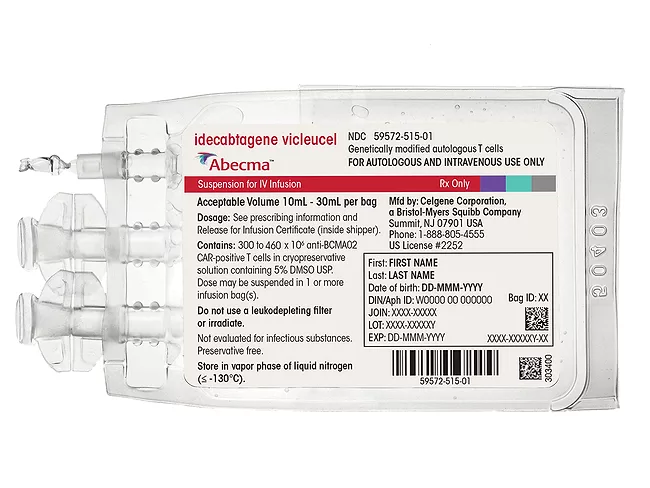
The first BCMA-targeted CAR T therapy, idecabtagene vicleucel, cleared FDA approval for use in adults with multiple myeloma (MM) who have received four or more prior lines of therapy. Developed by partners Bluebird Bio Inc. and Bristol Myers Squibb Co., the drug, branded Abecma, is also the first CAR T drug indicated for MM. It is designed for use as a one-time infusion, with a recommended dose range of 300 to 460 x 106 CAR-positive T cells. The personalized therapy will be produced at BMS’ cellular manufacturing facility in Summit, N.J. Bluebird developed the lentiviral vector used in Abecma.
Just weeks after two unexpected cases of blood cancer landed trials of its investigational gene therapies for sickle cell disease (SCD) and beta-thalassemia on FDA-issued clinical holds, Bluebird Bio Inc. said it's talking to regulators about their resumption after what RBC analyst Luca Issi called a "partial exoneration" of the BB-305 lentiviral vector shared between the medicines.
As the March 27 PDUFA date nears for idecabtagene vicleucel (ide-cel, also known as BB-2121), the B-cell maturation antigen (BCMA)-directed chimeric antigen receptor CAR T-cell therapy from Bristol Myers Squibb Co. and Bluebird Bio Inc., investors are looking with increased favor on the approach.