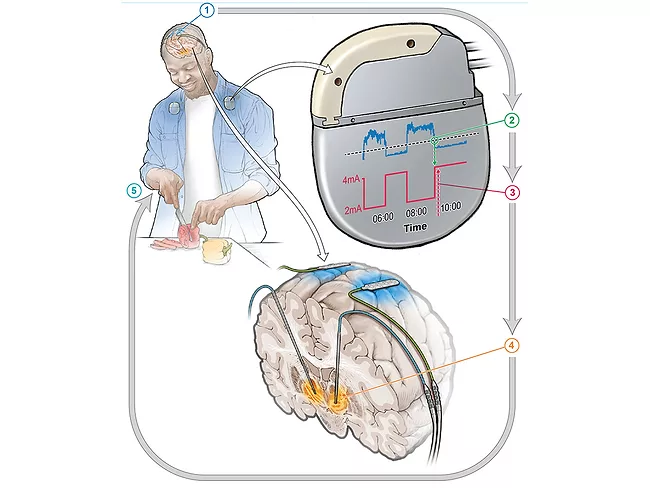
The U.S. FDA recently granted Medtronic plc approval for its deep brain stimulation (DBS) system to be used to treat Parkinson’s disease or essential tremor while a patient is asleep, under general anesthesia. The approval gives patients another option for DBS therapy which can transform their quality of life, Amaza Reitmeier, vice president and general manager for Medtronic brain modulation, told BioWorld in an interview.
A new brain-computer interface (BCI) developed at UC Davis Health is able to translate brain signals into speech with up to 97% accuracy – the most accurate system of its kind.
An implanted deep brain stimulator that calibrates its electrical pulses based on changes in brain activity reduced patients’ most bothersome symptoms of Parkinson’s disease 50%, a small feasibility study published in Nature Medicine found.
Otsuka Precision Health Inc. and Click Therapeutics Inc. pondered the signature question of cognitive behavioral therapy when setting the market approach for their jointly developed prescription digital therapeutic for major depressive disorder, Rejoyn.
In what represents the first patenting to emerge in the assignee’s name, additional protection is being sought for Rapidpulse Inc.’s aspiration system, which delivers high-frequency pulsed vacuum forces to increase the efficiency of aspiration thrombectomy and remove thrombus from the neurovasculature.
Seoul, South Korea-based Adel Inc. raised ₩17 billion (US$12.39 million) in bridge financing to advance its pipeline of Alzheimer’s disease therapies, including its tau antibody-based ADEL-Y01 candidate, currently in a U.S.-based phase I study.
Sunbird Bio Inc.’s Neural EV-tau aggregate assay demonstrated 92% correlation with PET scans in identifying individuals with Alzheimer’s disease, a study presented at the Alzheimer’s Association International Conference in Philadelphia, on July 30 found.
C2N Diagnostics LLC’s two-factor blood test, Precivity AD2, showed 90% accuracy in diagnosing Alzheimer’s disease in a study presented at the Alzheimer’s Association International Conference in Philadelphia on July 28 and simultaneously published in the Journal of the American Medical Association. The following day, Quanterix Corp. presented results from its study that showed a multi-marker approach could maintain the 90% accuracy of its Lucentad test, while reducing the percentage of uncertain results from more than 30% to 10%, in line with the intermediate results demonstrated by Precivity.
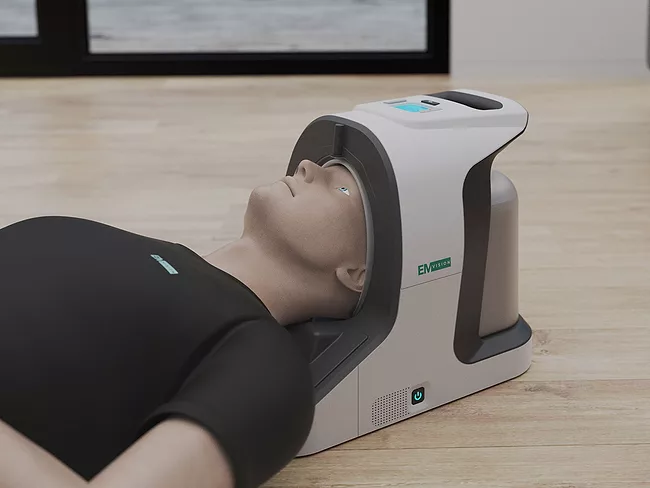
Emvision Medical Devices Ltd. unveiled a portable brain scanning helmet for first responders to quickly identify whether a patient is experiencing a stroke and, if so, what type.
In what represents the first patenting to emerge from Braincapture ApS, its chief executive officer, Tue Lehn-Schiøler, describes the development of a low-cost, portable electroencephalogram device designed to enhance neurological diagnostics in underserved communities around the world.
 RSS
RSS