The FDA reported the elevation of its information technology (IT) office to an agency-level office, a move that gives the agency a heightened priority for eliminating some of the balkanization of computer systems.
There are few guidelines of any sort that are specific to artificial intelligence (AI) for medical devices, but that doesn’t mean there are no signposts for developers. There are existing product marketing authorizations that offer some insights, but the FDA’s Bakul Patel said a risk stratification guidance by the International Medical Device Regulators Forum (IMDF) is an example of a non-AI blueprint for how the FDA will ultimately approach regulation of AI.
The share price of Renovorx Inc. has spiked following FDA clearance for its Renovocath delivery system. Since the company announced the clearance, its stock (NASDAQ:RNXT) has climbed by more than 13%. Last month the company completed an IPO for approximately $16.6 million, issuing shares at $9-$11.
The U.S. Department of Health and Human Services (HHS) reported a rescission of a September 2020 policy that would require that the secretary of health and human Services sign off on any rulemaking by HHS agencies. Despite the firestorm of criticism that followed the issuance of the September 2020 policy, attorney Jim Shehan, of Lowenstein Sandler, told BioWorld that the rulemaking process will remain exceptionally cumbersome, leaving in place a status quo that itself has been the target of repeated criticism.
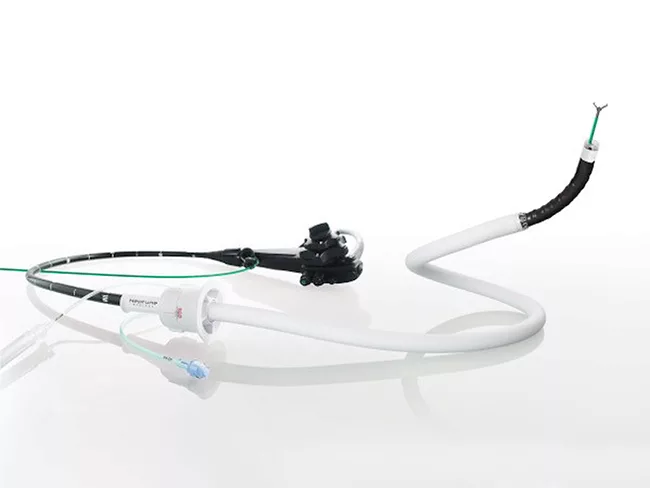
Multiple sizes of Neptune Medical LLC’s overtube for gastrointestinal (GI) procedures that allows thin-walled tubes to toggle between flexible and rigid states received FDA clearance. With the clearance, the Burlingame, Calif.-based company now has nine sizes of cleared single-use overtubes with more in the wings. The Pathfinder endoscope overtube device uses Neptune’s Dynamic Rigidization technology to keep tubes from looping during procedures, a problem that leads to procedure failure, patient pain and complications in colonoscopy and other GI procedures.
Aatru Medical LLC has received FDA 510(k) class II clearance for a platform that turns its back on electro-mechanical components in other negative pressure wound therapy (NPWT) systems. Deployed for closed surgical incision applications, the Negative Pressure Surgical Incision Management System (NPSIMS) is a single-use, disposable platform that could help reduce the 20% of hospital infections attributed to surgical site infections (SSI).
The Medical Device Innovation Consortium (MDIC) has launched a digital health initiative that will aid the FDA in its efforts to devise a workable regulatory system for these products, which includes a work stream for change control. This work stream promises to be a massive effort, but Joe Sapiente, MDIC's vice president for clinical science and technology, told BioWorld that MDIC needs subject matter experts in this and several other areas to sustain the group’s momentum and thus aid the FDA’s efforts to produce guidance for digital health products.
The FDA has designated Impedimed Ltd.’s Sozo digital health platform a breakthrough device for renal failure, paving the way for the first FDA approved device to measure fluid volume in the dialysis setting.
Although COVID-19 is still dictating how things are done in the U.S. and throughout the world, the FDA looked beyond the pandemic in an update to its guidance on conducting clinical trials of medical products during the public health emergency.
Digital health has made only limited headway in the orthopedics space, but Zimmer Biome Inc. and Canary Medical Inc. have nudged the cause along with a smart implant that blends a 21st century sensor with a traditional knee replacement device. The marriage of Zimmer’s Persona knee implant and the Canary Medical Canturio TE sensor will give physicians a better way to track the patient’s recovery from knee replacement procedures.
 RSS
RSS