With the lack of public trust and confidence the biggest barrier to SARS-CoV-2 vaccines in the U.S., the risk of granting an emergency use authorization to a vaccine with safety issues or questionable efficacy could destroy confidence in future FDA-approved products. That message was drummed home throughout the Oct. 22 meeting of the FDA’s Vaccines and Related Biological Products Advisory Committee.
The U.S. FDA’s recent decision to pass on any emergency use authorization (EUA) filings for tests for the COVID-19 pandemic is well known, but the agency had a chance to lend some additional information on that question in the Oct. 21 town hall. Despite the opportunity to clarify some of the underlying questions, Tim Stenzel, director of the Office of In Vitro Diagnostics and Radiological Health (OIR), said little more than that the change was made “largely because the FDA cannot require an EUA, according to the HHS statement.”
Digital medicine startup Appliedvr Inc. has gained breakthrough device designation status from the U.S. FDA for its virtual reality (VR) platform for treating treatment-resistant fibromyalgia and chronic intractable lower back pain. The designation follows the completion of a clinical trial assessing VR-based therapy for self-management of chronic pain at home.
While the FDA’s approach to evaluating safety and efficacy in the development and review of COVID-19 vaccines for the U.S. market will be at the center of its Oct. 22 advisory committee meeting, the panel also will be asked to discuss the practicalities, and ethics, of continuing to conduct trials once a candidate has been granted an emergency use authorization.
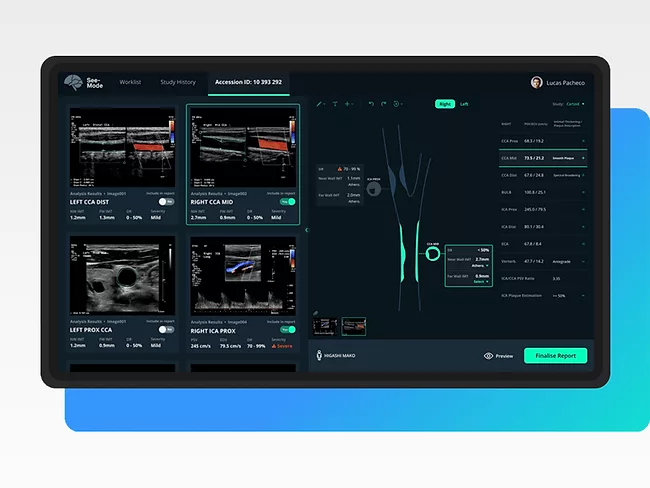
PERTH, Australia – See-Mode Technologies has received 510(k) clearance from the U.S. FDA to market its Augmented Vascular Analysis (AVA) program that uses artificial intelligence (AI) to analyze vascular ultrasound scans to better predict stroke. Caused by plaque that ruptures in blood vessels and blocks blood flow to the brain, stroke affects roughly 15 million people per year and is the second-leading cause of death globally.
The U.S. FDA cleared Ezra AI Inc.'s artificial intelligence (AI) system for prostate cancer and its cloud-based picture archiving and communication system (PACS) that enables radiologists to use the Prostate AI from their browser. The New York-based company’s Prostate AI is the first prostate-focused artificial intelligence system to gain clearance. The Prostate AI accurately quantifies prostate volume, lesion size, and renders 3D volumes of the prostate gland and lesions.
The U.S. FDA’s device center has declared it will not review emergency use authorization (EUA) requests for lab-developed tests (LDTs) for the COVID-19 pandemic, but on the agency’s most recent town hall, on Oct. 14, FDA officials were uncertain as to whether labs should file those EUAs, leaving labs in a state of limbo yet again.
The latest global regulatory news, changes and updates affecting medical devices and technologies, including: NIST ramps up Zero Trust cybersecurity program; TGA sets date for mesh up-classification; IMDRF posts post-market study update; ANVISA updates list of non-regulated devices.
The news that the U.S. FDA has opened a new digital health office carries some significant expectations for stakeholders, expectations that may take time to meet. More than one participant in the Oct. 19 FDA listening session for the Digital Health Center of Excellence (DHCoE) called on the FDA to ensure that this new center provides more regulatory clarity regarding a number of products, a task that may be some time in coming, given the need to harmonize with other national and international regulatory entities.
The latest global regulatory news, changes and updates affecting medical devices and technologies, including: FDA’s cybersecurity discussion paper emerges; CMS eyes MAC default for Allomap coverage; CMS floats draft coverage for CRC screening test.
 RSS
RSS