The U.S. FDA reported Feb. 15 that Philips USA, a subsidiary of Amsterdam-based Royal Philips NV, recalled three models of the Brightview line of single photon emission CT (SPECT) systems due to an incident in which the system detector fell.
Wandercraft SAS broadened its U.S. FDA clearance for the Atalante X to include rehabilitation in individuals with spinal cord injuries at levels T5 to L5. The self-balancing exoskeleton was already given the greenlight by the FDA for use in stroke rehabilitation in December 2022. “We are thrilled to have two FDA clearances, first for stroke and now spinal cord injury, in less than a year,” CEO Matthieu Masselin, told BioWorld.
Just in time for Valentine’s Day, the circulatory system devices panel of the medical devices advisory committee for the U.S. FDA showed some love for Abbott Laboratories’ Triclip transcatheter edge-to edge repair (TEER) system for leaky tricuspid heart valves.
The U.S. FDA has posted information on the regulatory review period for several medical devices that incorporate patented inventions, such as the determination for the Simplify artificial cervical disc by Simplify Medical Inc., of Sunnyvale, Calif. According to the FDA, the company seeks to tack nearly 1,100 days back on to the patent in question, an additional three years that may play a significant role in the company’s attempt to monetize the patent in question.
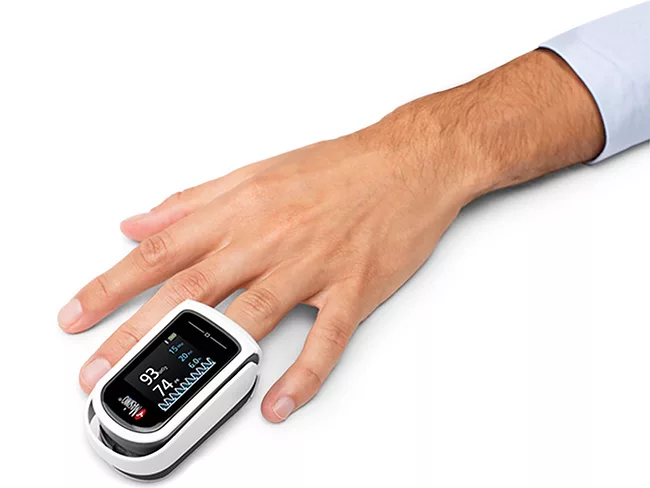
Masimo Corp. received a pinch of good news with the U.S. FDA’s clearance of its medical-grade fingertip pulse oximeter, Mightysat Medical, for over-the-counter (OTC) sale. The device uses the same technology as Masimo’s Set pulse oximetry used in hospitals and clinics.
The U.S. FDA has released a draft guidance for the use of data monitoring committees (DMCs) for clinical trials for devices and drugs, which would overwrite a similar guidance from 2006. This new draft guidance explicitly states that clinical studies more commonly employ DMCs than was the case 18 years ago and would seem to suggest that the agency will more routinely require the use of DMCs than was common practice in the past.
The U.S. FDA recently convened an advisory hearing to review the agency’s list of essential items for public health emergencies and led the hearing with its own list to which the advisory committee recommended numerous additions. How the FDA will respond remains to be seen, but the FDA’s list may grow significantly larger despite that industry representatives advised that existing supply chain redundancies would seem to suggest that some devices and associated items need not be subject to FDA supply chain oversight.
It’s been a good month for Illuminoss Medical Inc. In less than three weeks, the East Providence, R.I.-based company received U.S. FDA clearance of its new light-emitting diode (LED) console, achieved the 10,000th use of its bone-strengthening technology and presented promising results of research on use of its signature blue light for antimicrobial applications.
Boston Scientific Corp. notched another win with the U.S. FDA approval of its spinal cord stimulator (SCS), Wavewriter, for treatment of non-surgical back pain just a week after receiving the agency’s nod for its Farapulse pulsed field ablation system. The new indication comes four months after expansion of approved uses for Wavewriter to include painful diabetic peripheral neuropathy.
The U.S. Medicare program for coverage of U.S. FDA-designated breakthrough devices has gone through some significant alterations over the past few years, but there is legislation on Capitol Hill that would codify this program at the Centers for Medicare & Medicaid Services. Mark Leahey, president and CEO of the Medical Device Manufacturers Association (MDMA), told BioWorld that one of the sources of drag on this kind of legislation is how the Congressional Budget Office (CBO) scores the legislation, a problem that might not be resolved until CBO works through other legislation.
 RSS
RSS