Awak Technologies Pte Ltd. gained the U.S. FDA’s breakthrough designation for an artificial intelligence (AI)-based kidney disease progression prediction (KDDP) model on Nov. 27, following its $20 million fundraising that marked one of Singapore’s largest med-tech financings in 2023.
The U.S. Federal Trade Commission is clearly a more activist agency of late, although much of that activism has been around mergers and acquisitions. The latest FTC move, however, deals with investigative authorities that will be applied toward artificial intelligence (AI), which Katie Bond of Keller & Heckerman LLP said will give the agency considerable powers of discovery regardless of the merits of the enforcement action.
The U.S. FDA cleared respiratory imaging technology company 4dmedical Ltd.’s computed tomography lung ventilation analysis software (CT LVAS) that is nearly identical to its X-ray velocimetry technology but uses CT imaging and provides greater access to the four-dimensional imaging technology.
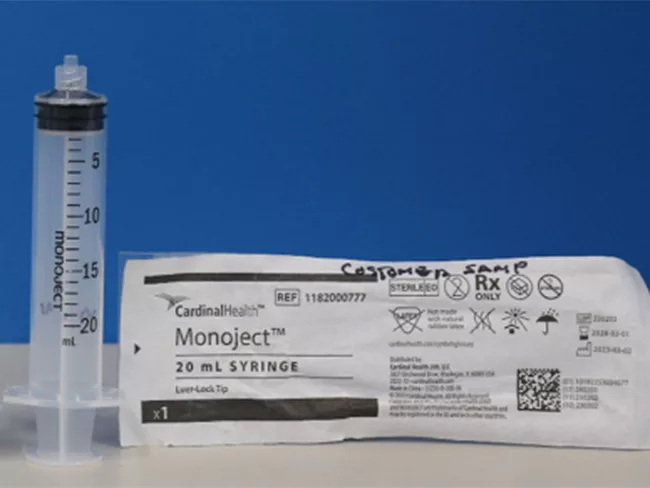
The U.S. FDA advises health care providers (HCPs) to avoid using Monoject syringes distributed by Cardinal Health with syringe pumps or patient-controlled analgesia (PCA) pumps because of incompatibilities between the Monoject interface and the pumps.
The U.S. FDA’s predetermined change control program (PCCP) is the talk of the med-tech town, but this novel regulatory mechanism has its limitations, said Cassie Scherer, senior director for digital health policy at Medtronic plc.
The renal denervation hypothesis of hypertension was initially viewed with some skepticism, and Dublin-based Medtronic plc. endured a major setback when clinical trial data failed to make a compelling case for approval for the Symplicity Spyral. However, the company finally landed an FDA approval for the device, opening the gates to a new and significant market opportunity even with competition already on the market.
South Korea’s Ministry of Food and Drug Safety (MFDS) will head an international team of regulatory experts from 19 drug agencies worldwide, including the U.S. FDA and China National Institute for Food and Drug Control (NIFDC), to draft an international standard for artificial intelligence (AI)-based software.
Janet Woodcock, one of the longer-tenured U.S. FDA center directors in the agency’s history, is set to retire sometime in 2024, although the exact date has not been set.
The U.S. FTC’s policing of Orange Book patent listings begs the question of when, and whether, the FDA will deliver on its commitment to provide more clarity on the types of device patents that can be listed as covering a “drug product.”
After Cormedix Inc. navigated manufacturing issues that slowed the process, the U.S. FDA approved the antibacterial and antifungal solution Defencath to reduce catheter-related bloodstream infections adults with kidney failure.
 RSS
RSS