Neurometrix Inc. secured breakthrough device designation from the FDA for its Quell technology for chemotherapy-induced peripheral neuropathy (CIPN) just six months after receiving the designation for fibromyalgia in July 2021. Quell is a wearable, credit card-sized transcutaneous electrical nerve stimulation (TENS) device worn on the upper calf that delivers self-adjusting, high-power nerve stimulation that disrupts pain signals sent to the brain.
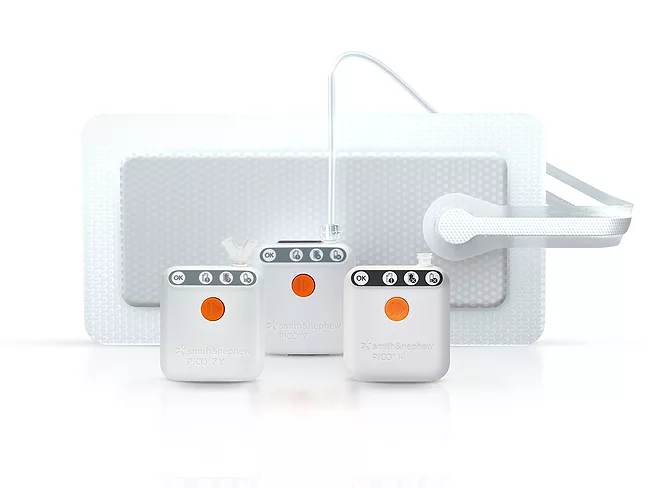
Smith & Nephew plc added new indications for use of its Pico 7 and Pico 14 single-use negative pressure wound therapy (sNPWT) systems. The FDA cleared the London-based device maker’s systems for reducing the incidence of both deep and superficial incisional surgical sites and dehiscence. Smith & Nephew’s Pico 7Y system, which treats two wounds simultaneously, was also cleared to aid in the reduction of the incidence of superficial incisional SSIs for high-risk patients in class I wounds, post-operative seroma and dehiscence.
Medtronic plc received FDA premarket approval Friday for use of its Intellis rechargeable and Vanta recharge-free neurostimulators in patients with diabetic peripheral neuropathy (DPN), suddenly tripling the number of spinal cord stimulators approved for the indication. Medtronic’s implantable spinal cord stimulators (SCS) now join Nevro Corp.’s HFX, which has had the distinction since July 2021 of being the only device with FDA approval for DPN, also known as painful diabetic neuropathy (PDN).
The FDA announced a class I recall of the Medtronic Hawk One directional atherectomy catheter system due to more than 160 reports of problems with the device’s guidewire. The catheter tip could break or separate when the guidewire prolapses, a problem that is associated with 55 injuries and no deaths, but the recall affects more than 95,000 units.
The FDA posted a recall of a vaporizer unit that is used in several anesthesia gas machines distributed by Getinge USA Sales LLC, of Wayne, N.J., an issue that has triggered eight complaints. While no injuries or deaths have been reported, this is a class I recall due to the prospect that the problem can trigger irritation of the lung as well as pulmonary edema.
The COVID-19 pandemic has hit supplies and devices across a broad range of categories over the past two years, and the latest addition to the list is the blood collection tube. The FDA announced that this shortage affects all types of blood collection tubes, thus affecting tubes for all uses, not just those used for testing for the SARS-CoV-2 virus.
With the evidence that sex and gender both significantly affect the course of many diseases and the function of medical devices rapidly mounting, the FDA’s Center for Devices and Radiological Health (CDRH) released its strategic plan to better understand these differences.
Robert Califf moved a step closer to his second stint as head of the U.S. FDA when the Senate Health, Education, Labor and Pensions (HELP) Committee voted 13-8 Jan. 13 to favorably send his nomination to the full Senate for a confirmation vote.
Abbott Laboratories received FDA 510(k) clearance for the Ensite X EP system with Ensite omnipolar technology, the company’s cardiac mapping platform. The system, which is used to identify and treat abnormal heart rhythms such as atrial fibrillation, produces detailed three-dimensional maps of the heart to guide physicians performing ablation procedures.
The FDA reported a class I recall of the Wirion embolic protection device by Cardiovascular Systems Inc. (CSI), of St. Paul, Minn., due to reports of nine instances of device malfunction. The agency said the filter portion of the device can be difficult to withdraw under some circumstances and thus lead to separation, although the FDA noted that no deaths have been reported in association with the issue despite the risk of embolization. The FDA’s device center also posted a Jan. 11 notification against the use of two tests by Lusys Labs Inc., of San Diego, for the SARS-CoV-2 virus.
 RSS
RSS