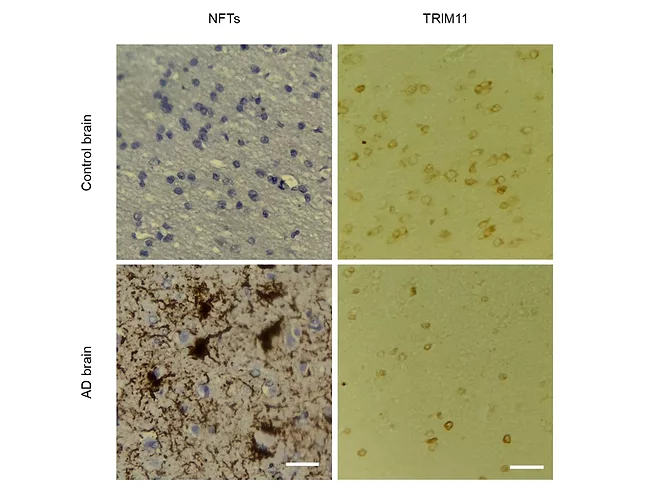
Protein quality control research is “almost exclusively focused on heat shock proteins, which are ubiquitously present” up and down the evolutionary chain, Xiaolu Yang told BioWorld. But “for more sophisticated organisms, which we humans like to think we are, it’s a little odd that we still use the system that bacteria started with…. It seems like we should have something more. The TRIM system,” he added, “fills that gap.”
TRIMs or tripartite motif proteins are a group of quality control proteins that are found only in animals. One of their functions is to add ubiquitin tags to proteins, marking them for transport to the proteasome system. TRIMs are part of the innate antiviral defense system. But in the July 27, 2023, issue of Science, Yang, who is a professor of cancer biology in the Perelman School of Medicine at the University of Pennsylvania, and his colleagues reported that TRIM11 interacts with tau protein in multiple ways that were beneficial in preventing tauopathies.
The identification of new targets in diseases of the central nervous system (CNS) such as Alzheimer’s and Parkinson’s – conditions which continue to have significant unmet needs – has taken a small step forward as one company, Violet Therapeutics Inc., plans to put $10.6 million in seed funding toward building out a pipeline based on technologies that elucidate the way cells interact amongst one another.
Viage Therapeutics Inc. – formerly Digestome Therapeutics Inc. – on July 26 unveiled positive data from its phase I study on DGX-001 for mild cognitive impairment in Alzheimer’s disease (AD) and Parkinson’s (PD). The randomized, double-blind, placebo-controlled study demonstrated changes in brain activity according to quantitative electroencephalography (qEEG) measurements in 68 healthy volunteers dosed with single ascending and multiple ascending doses.
The identification of new targets in diseases of the central nervous system (CNS) such as Alzheimer’s and Parkinson’s – conditions which continue to have significant unmet needs – has taken a small step forward as one company, Violet Therapeutics Inc., plans to put $10.6 million in seed funding toward building out a pipeline based on technologies that elucidate the way cells interact amongst one another.
Researchers from Arizona State University presented preclinical data for the novel dual specificity tyrosine phosphorylation kinase 1a (DYRK1a) inhibitor DYR-533, being developed for the treatment of tauopathies, including Alzheimer’s disease (AD).
The growing number of drugs gaining U.S. FDA approval for Alzheimer’s disease has kept their ability to reduce amyloid beta and tau proteins in the news, but the degenerative disease is not simply a matter of tangles and deposits. A loss of synaptic plasticity and disrupted neural networks underlie the signature impairment of memory and cognition – and those, researchers showed in a recent study in Brain, can be strengthened by non-invasive stimulation that addresses the brain’s electrical dysfunction.
The identification of new targets in diseases of the central nervous system (CNS) such as Alzheimer’s and Parkinson’s – conditions which continue to have significant unmet needs – has taken a small step forward as one company, Violet Therapeutics Inc., plans to put $10.6 million in seed funding toward building out a pipeline based on technologies that elucidate the way cells interact amongst one another.
With the launch of intravenous Leqembi (lecanemab-irmb) for Alzheimer’s disease (AD) underway, Priya Singhal, Biogen Inc.’s head of development and interim head of research, said the firm, along with partner Eisai Co. Ltd., aims to “address the long-term duration question” with a subcutaneous version, recently touted at the Alzheimer's Association International Conference.
Tonix Pharmaceuticals Holding Corp. has released data supporting the memory- and cognition-enhancing effects of TNX-4300 (estianeptine), the single (S)-isomer of tianeptine in preclinical development for depression, bipolar disorder, Alzheimer’s disease and Parkinson’s disease.