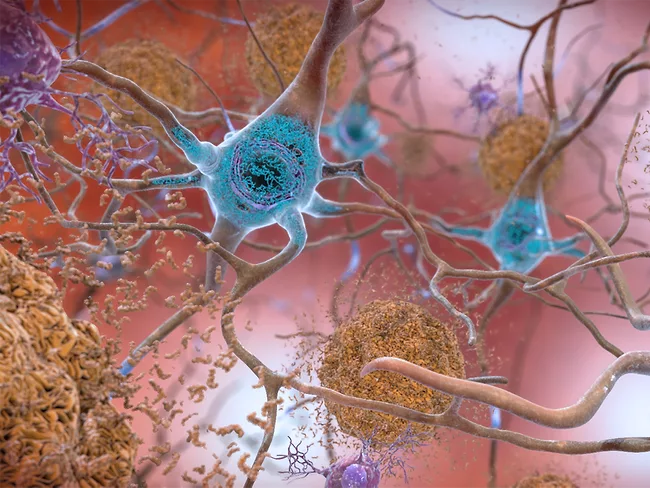
Inhibiting the aggregation process of Aβ42 is one of the main objectives in the development of therapies for Alzheimer’s disease, but the heterogeneous nature of the neurotoxic oligomers poses a significant challenge. Researchers from the Universita degli Studi di Firenze presented the preclinical evaluation of DesAb-O, a single-domain antibody targeting Aβ42 oligomers.
Quibim SL recently launched its artificial intelligence (AI)-based software QP-Brain, which is designed to detect early-stage neurodegenerative diseases, after it received U.S. FDA 510(k) clearance, as well as CE and UKCA marks from the EU and U.K. regulators, respectively. QP-Brain quantifies and presents data from patients’ brain images to help clinicians with early diagnosis and treatment strategies for diseases such as Alzheimer’s, multiple sclerosis and dementia.
Current risk genes for some diseases such as multiple sclerosis (MS) may have emerged in the past as protection against infection by different pathogens. A group of researchers led by scientists from the University of Copenhagen has analyzed the ancient DNA of European populations and has revealed how MS, Alzheimer’s disease (AD) and diabetes arose as populations migrated. This evolution would explain the modern genetic diversity and the incidences of these pathologies observed today in the old continent.
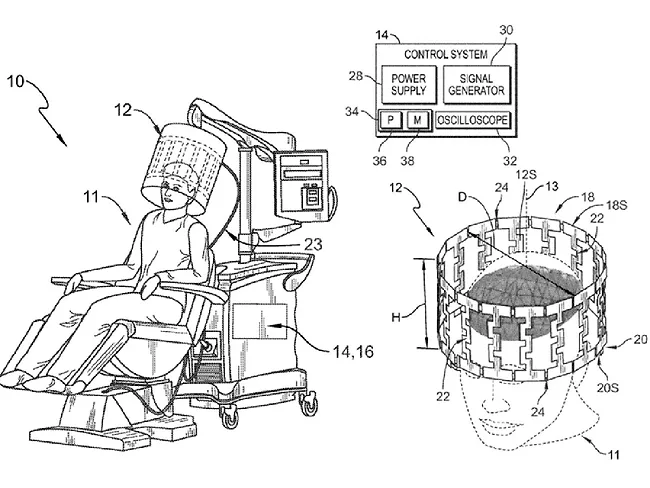
Researchers from Indiana University are seeking patent protection for an electromagnetic field (EMF) generation system for treating neurodegenerative diseases. The EMF generation system emulates a small-scale magnetic resonance imaging (MRI) machine, producing the same 64 MHz frequency at a much lower operating power.
Current risk genes for some diseases such as multiple sclerosis (MS) may have emerged in the past as protection against infection by different pathogens. A group of researchers led by scientists from the University of Copenhagen has analyzed the ancient DNA of European populations and has revealed how MS, Alzheimer’s disease (AD) and diabetes arose as populations migrated. This evolution would explain the modern genetic diversity and the incidences of these pathologies observed today in the old continent.
Eisai Co. Ltd. and Oita University in Oita Prefecture, Japan, developed a first-of-its-kind machine learning model to predict amyloid beta accumulation in the brain using a wristband sensor. The model, which collects biological and lifestyle data from daily life, is expected to enable screening for brain amyloid beta accumulation to identify those at risk for Alzheimer's disease, particularly because amyloid beta begins to accumulate in the brain about 20 years before the onset of the disease.
Alzheimer’s disease (AD) can be divided into five distinct subtypes based on protein expression levels measured in the cerebrospinal fluid (CSF). The subtypes were associated with different genetic risk factors and are likely to benefit from different treatment approaches.
Many clinicians, drug developers and the general public still “think of Alzheimer’s as a single disease entity, and that suggests that every patient needs to have the same medication,” Betty Tijms told BioWorld.
Eisai Co. Ltd. and Oita University in Oita Prefecture, Japan, developed a first-of-its-kind machine learning model to predict amyloid beta accumulation in the brain using a wristband sensor. The model, which collects biological and lifestyle data from daily life, is expected to enable screening for brain amyloid beta accumulation to identify those at risk for Alzheimer's disease, particularly because amyloid beta begins to accumulate in the brain about 20 years before the onset of the disease.
Anavex Life Sciences Corp.’s stock (NASDAQ:AVXL) sunk 35% on Jan. 2 after a phase II/III study failure in Rett syndrome but posted a next-day rebound of 8% on Jan. 3 with shares closing at $6.53 each. Top-line data from the randomized, double-blind, placebo-controlled study of the company’s lead asset, Anavex 2-73 (blarcamesine), showed improvement but did not reach statistical significance on the co-primary endpoint, the Rett Syndrome Behaviour Questionnaire.