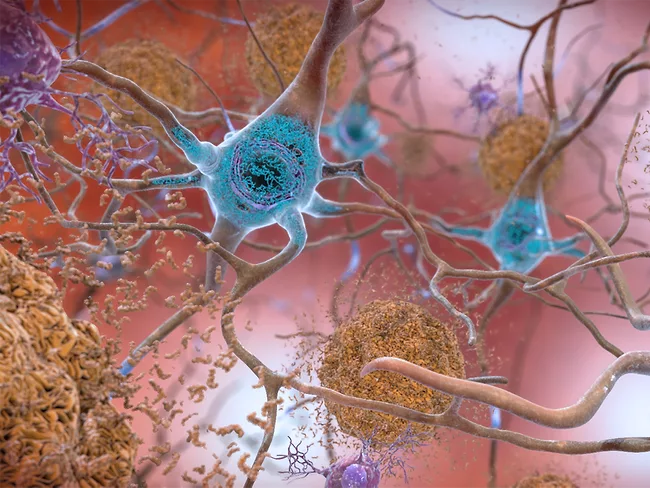
Vivoryon Therapeutics NV said it will conduct an in-depth analysis after reporting top-line data showing the phase IIb European Viviad study testing its oral small molecule, varoglutamstat, in patients with early Alzheimer’s disease missed statistical significance on the primary endpoint measuring changes in cognition over time. Investors, however, opted for a more immediate reaction, sending company shares (Euronext Amsterdam:VVY) plunging 90% March 4, to close at €0.80 (US87 cents)
Neurocode USA Inc. added Alzpath Dx, a blood test for Alzheimer’s disease screening, to its lab developed tests, making it the first available for commercial use in the U.S. The move stands to make screening for the neurodegenerative disease much more accessible, as recent study results indicate Alzpath’s accuracy rivals PET scans and cerebrospinal fluid tests, the current gold standards, in detecting the signature biomarkers of the disease.
Biovie Inc.’s double-barrelled blast of positive data with insulin sensitizer NE-3107 in Alzheimer’s disease (AD) and Parkinson’s disease (PD) launched shares (NASDAQ:BIVI) on a wild ride to close March 1 at $2.23, up 99 cents, or almost 80%, after trading as high as $3.31.
Igc Pharma Inc. has reported results of preclinical studies investigating TGR-63 as a treatment for Alzheimer’s disease, showing enhanced memory function in an Alzheimer’s mouse model, including improved memory acquisition, consolidation and retrieval.
Separate teams of investigators have reported new insights into how the brain disposes of metabolic waste via the glia-based lymphatic system, or glymph system. In two papers published in Nature on Feb. 28, 2024, scientists from Washington University in St. Louis described how in sleeping animals, the synchronized activity of neurons drove ionic gradients that facilitated the movement of fluid through brain tissue. And researchers from the Massachusetts Institute of Technology showed that, in a mouse model of Alzheimer’s disease (AD), the glymphatic system mediated clearance of amyloid-β after sensory stimulation at a 40-Hertz rhythm.
With the number of people with dementia in Australia expected to nearly double by 2054, the federal government is funding a new AU$50 million (US$32.76 million) biomedical and med-tech incubator program to develop new therapies, medical devices and digital health technologies to address dementia and cognitive decline.
Korean neurodegenerative disease-focused Aribio Co. Ltd. gained the U.K.’s regulatory clearance to start the phase III Polaris-AD trial on AR-1001 (mirodenafil), an investigative therapy for early Alzheimer’s disease (AD). The U.K.’s Medicines and Healthcare products Regulatory Agency gave notice of acceptance to Seoul, South Korea- and San Diego-based Aribio for the clinical study on Feb. 21 after “confirming a favorable ethical opinion,” Aribio said. AR-1001 is an oral phosphodiesterase-5 inhibitor under development to treat early AD.
Korean neurodegenerative disease-focused Aribio Co. Ltd. gained the U.K.’s regulatory clearance to start the phase III Polaris-AD trial on AR-1001 (mirodenafil), an investigative therapy for early Alzheimer’s disease (AD). The U.K.’s Medicines and Healthcare products Regulatory Agency gave notice of acceptance to Seoul, South Korea- and San Diego-based Aribio for the clinical study on Feb. 21 after “confirming a favorable ethical opinion,” Aribio said. AR-1001 is an oral phosphodiesterase-5 inhibitor under development to treat early AD.
With the number of people with dementia in Australia expected to nearly double by 2054, the federal government is funding a new AU$50 million (US$32.76 million) biomedical and med-tech incubator program to develop new therapies, medical devices and digital health technologies to address dementia and cognitive decline.
A new cutting-edge blood-based biomarker test developed by researchers at Hong Kong University of Science and Technology can detect early Alzheimer’s disease (AD) and mild cognitive impairment (MCI), with accuracy rates surpassing 96% and 87% respectively, and could be a game changer in detecting and treading early AD.