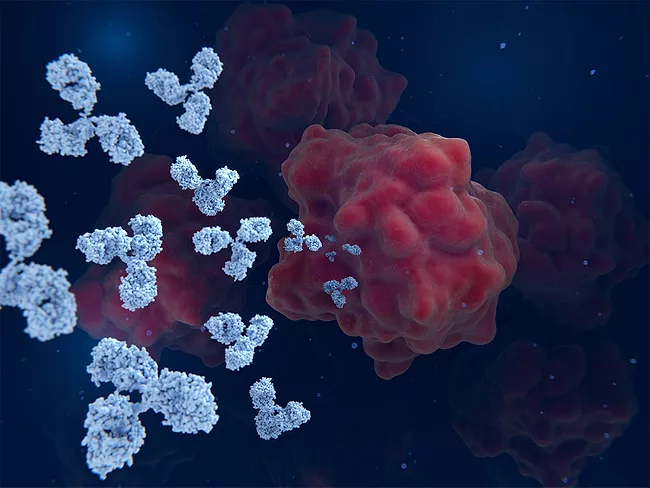
Bacteria also defend themselves against pathogen attacks using mechanisms like those of the immune system. But if there is a system to repel an attack, it can also be dismantled. Scientists at the University of Southampton have described the components of Kiwa, a protein complex that blocks the entry of phage DNA, which are viruses that infect bacteria. They have also uncovered how Kiwa interacts with other bacterial defense strategies.
Formation Bio Inc. has licensed worldwide rights to Imidomics Inc.’s potentially first-in-class anti-CD226 monoclonal antibody (mAb). The program has received IND clearance and will be advanced by Formation Bio in autoimmune indications, starting with ulcerative colitis.
Hengrui Pharmaceuticals Co. Ltd. is out-licensing to GSK plc its potential best-in-class phase I phosphodiesterase 3 and 4 inhibitor (HRS-9821) for treating chronic obstructive pulmonary disease along with 11 additional programs in development for $500 million up front and up to $12 billion in potential milestones.
Chinese financings are picking up, with Everest Medicines Ltd. raising US$200 million and Nanjing-based Leads Bioloabs Co. Ltd. listing on the main board of the Hong Kong Stock Exchange in a $189 million IPO.
Chinese financings are picking up, with Everest Medicines Ltd. raising US$200 million and Nanjing-based Leads Bioloabs Co. Ltd. listing on the main board of the Hong Kong Stock Exchange in a $189 million IPO.
Hengrui Pharmaceuticals Co. Ltd. is out-licensing to GSK plc its potential best-in-class phase I phosphodiesterase 3 and 4 inhibitor (HRS-9821) for treating chronic obstructive pulmonary disease along with 11 additional programs in development for $500 million up front and up to $12 billion in potential milestones.
F. Hoffmann-La Roche Ltd. and Hoffmann-La Roche Inc. have discovered new heteroarylphenyl ether derivatives acting as cyclin-dependent kinase CDK8/cyclin C inhibitors. As such, they are reported to be useful for the treatment of graft-vs.-host disease, transplant rejection, multiple sclerosis, rheumatoid arthritis, atopic dermatitis, psoriasis, amyotrophic lateral sclerosis and stroke, among others.
The autoimmune disorder systemic lupus erythematosus (SLE) involves upregulation of IgD, and studies have shown that anti-IgD antibodies can alleviate the autoimmune disorder rheumatoid arthritis in mouse models. Building on this finding, researchers in Hefei and Changshu, China, have shown that interrupting the interaction between IgD and its receptor FcδR can reduce cytokine levels and phosphorylation of JAK2 and STAT3, suppressing the activation and proliferation of CD4+ T cells in SLE.
Researchers at the Fred Hutchinson Cancer Research Center found that autoantibodies targeting the exoproteome reshaped checkpoint inhibitor responses and opened new avenues to enhance immunotherapy. In the study published in the July 23, 2025, issue of Nature, the authors set out to address a long-standing question in cancer immunotherapy: why patients with the same type of cancer, treated with the same immunotherapy, can experience such drastically different outcomes.
Rheumatoid arthritis is a chronic, systemic autoimmune disease characterized by systemic inflammation and progressive joint destruction. Current treatments include conventional disease-modifying antirheumatic drugs and biologics. However, long-term treatment is frequently associated with drug resistance and significant adverse effects.
 RSS
RSS