Sinotau Pharmaceutical Group raised ¥1.1 billion (US$152 million) in a financing round to develop its radiopharmaceutical drugs for diagnostic and therapeutic interventions.
Cerevasc Inc. has formed a partnership with Lianmedical Co. Ltd. to introduce Cerevasc’s medical devices for neurological diseases in the Asian market. Shanghai-based Lianmedical will help market Cerevasc's eshunt system and related products in mainland China, Hong Kong, Taiwan, and Macau. It’s eshunt system provides percutaneous transvenous-transdural access to the central nervous system.
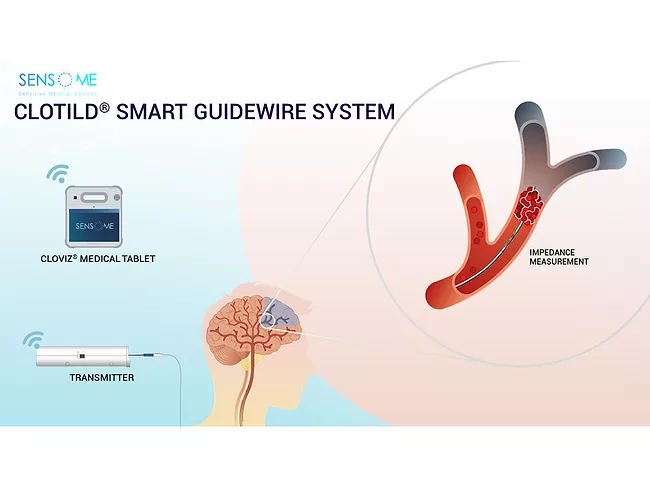
Sensome SAS reported a partnership with Asahi Intecc Co. Ltd. to develop the next generation Clotild smart guidewire. Asahi Intecc is taking on the manufacturing role for Sensome’s smart guidewire designed for the treatment of acute ischemic stroke.
A group of international partners with expertise in therapeutics, technology, health data management and data science have joined forces to develop a range of digital tools that will predict and monitor dementia. The two-year pilot project launched in the U.K. will see the unique group focus their initial efforts on developing data and digital solutions to complement existing treatments as well as solving issues related to the prediction, prevention, management and treatment of dementia related disorders.
Artificial intelligence (AI) continues to entice. On the exhibition floor at the 2023 Congress of the European Academy of Neurology, one company’s booth featured “Mindart” technology. A passersby could answer a short series of prompts, and get a unique image based on the input made by generative AI. Entertainment aside, medically speaking, AI applications “are still research,” Riccardo Soffietti told his audience at one of several sessions devoted to AI. “But obviously, research is the future.”
Carthera SA raised €37.5 million (US$40 million) in a series B funding round that will allow the company to embark on the first pivotal trial of its Sonocloud technology. The Sonocloud-9 is the only implantable ultrasound device that can repeatedly open the blood-brain barrier and deliver effective treatment in patients with recurrent glioblastoma, Frédéric Sottilini, CEO of Carthera, told BioWorld.
IA Medical SAS raised $1.5 million to accelerate the development of its Alix chatbot, designed to support and make life easier for caregivers of patients suffering from Alzheimer's disease. The Klesia GIE investment fund, which depends on Agirc-Arrco GIE, the administrator of the French private-sector pension scheme, and the French sovereign bank BPIFrance SA contributed 46.42% of the financing. More than half of this financing corresponds to an opening of IA Medical SAS's capital to individual partners, including doctors.
Cala Health Inc. expanded availability of its next-generation bioelectronic Kiq device for relief of action tremors to include individuals with Parkinson’s disease as well as essential tremor. The broad commercial launch of the FDA-cleared wrist-worn device will enable more patients to use the transcutaneous afferent patterned stimulation (TAPS) therapy, which studies show reduces tremors and improves performance of activities of daily living.
Aptamer Group plc and Neuro-Bio Ltd. have developed Optimer binders which could enable the creation of a lateral flow test for the early diagnosis of Alzheimer’s disease. Aim-listed Aptamer saw its share price soar on the news as early detection of Alzheimer could bring substantial benefits to patients, caregivers and health care systems and there is currently a lack of tests available for early stage diagnosis of the disease.
An artificial intelligence (AI) framework developed by researchers in Denmark has outperformed human emergency call handlers in identifying stroke. The AI tool has the potential to play a critical role in helping to address the number of strokes that go unrecognized as the number of strokes are projected to increase as the population ages.
 RSS
RSS