Intellia Therapeutics Inc. followed up troubling news in May with a similar, and worse, update regarding the Magnitude and Magnitude-2 phase III trials with nexiguran ziclumeran, also known as nex-z, for patients with transthyretin amyloidosis with cardiomyopathy and polyneuropathy, respectively.
Researchers at Dankook University and Korea University Research & Business Foundation Sejong Campus have identified thiophene derivatives acting as lysine-specific demethylase 4C (KDM4C; GASC-1; JMJD2C) inhibitors reported to be useful for the treatment of Alzheimer’s disease.
The largest study ever conducted on light therapy for Parkinson’s disease has found that long-term use of Symbyx Biome Pty Ltd.’s non-invasive, at-home photobiomodulation (PBM) devices significantly improved mobility, anxiety, and overall symptom severity.
Park City Bio LLC has prepared and tested new serotonin receptor agonists reported to be useful for the treatment of pain, inflammation, psychiatric and neurological disorders.
Do men’s and women’s brains age equally? Women are more often diagnosed with Alzheimer’s disease (AD) than men. Age is the primary known risk factor for AD prevalence, and both aging and AD are associated with brain atrophy, but it is still not clear whether men and women differ regarding brain decline in aging.
Solu Therapeutics Inc. has identified heterobifunctional cotinine-containing compounds acting as sodium channel protein type 10 subunit α (SCN10A; Nav1.8) blockers or sodium channel protein type 9 subunit α (SCN9A; Nav1.7) blockers. They are reported to be useful for the treatment of pain, cough and pruritus.
Nippon Shinyaku Co. Ltd. has disclosed compounds inhibiting binding between r(CUG) repeats in DMPK (DM1) and MBNL protein reported to be useful for the treatment of myotonic dystrophy 1.
Positive allosteric modulators (PAMs) of the muscarinic acetylcholine M4 receptor show potential against schizophrenia because they can enhance endogenous acetylcholine signaling, which in turn may mitigate psychotic symptoms as well as improve attention and working memory in individuals with the disorder. However, the efficacy of a promising PAM, CVL-231, has been disappointing in clinical trials.
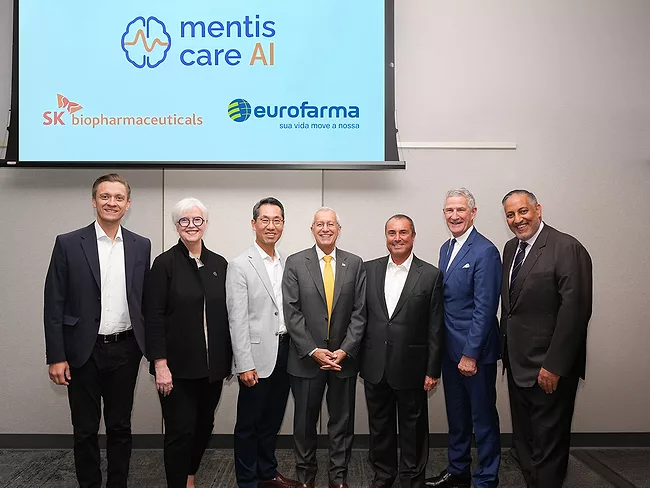
SK Biopharmaceuticals Co. Ltd. and Eurofarma Laboratórios SA launched a new joint venture (JV) called Mentis Care Inc. Oct. 21, dedicated to developing an AI-powered platform for epilepsy management.

 RSS
RSS