Biomedical research seems like it should be the ultimate bipartisan issue. But under the Trump administration, unless and until Congress regains its will to make use of its constitutional powers, bipartisan support for research seems to be a thing of the past.
Sangamo Therapeutics Inc. is adding a much-needed $18 million up-front payment in a neurology-focused deal with Eli Lilly and Co. that could bring up to an additional $1.4 billion. In return, Lilly gets access to Sangamo’s neurotropic adeno-associated virus (AAV) capsid, STAC-BBB, which has shown early promise in penetrating the blood-brain barrier penetration, for one initial target with the right to add up to four more.
Biomedical research seems like it should be the ultimate bipartisan issue. But under the Trump administration, unless and until Congress regains its will to make use of its constitutional powers, bipartisan support for research seems to be a thing of the past. On March 3, members of the National Academies of Science, Engineering and Medicine warned that the second Trump administration has been waging a “wholesale assault” on American research.
The Trump administration’s declaration of a new round of tariffs did not sit well with trade associations, but the impact of those tariffs may vary somewhat by company. Analysts said the lack of clarity regarding the impact of tariffs makes it difficult to predict the impact on the device and diagnostics industries, leaving investors and customers alike with a large overhang of uncertainty.
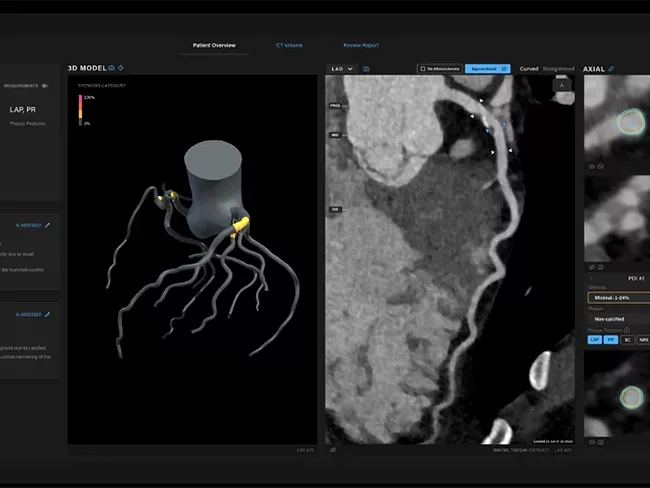
The U.S. FDA cleared Artrya Ltd.’s Salix Coronary Anatomy software that analyzes coronary computed tomography angiogram scans via AI to better diagnose coronary artery disease.
President Donald Trump’s executive order on global tariffs have pushed downward the stocks of biopharma and med-tech companies, even though the impacts of his 10% baseline tariff – which excludes pharmaceuticals – and his reciprocal tariffs affecting about 60 countries across the globe, are still unclear. “The story for the day is there’s still a lot of uncertainties in terms of pharmaceuticals,” said Wayne Winegarden, senior fellow and director of the Center for Medical Economics and Innovation at the Pacific Research Institute, a free-market think tank. “It’s going to pressure margins, pressure availability. This is just a complete negative for the industry. It’s self-inflicted. It’s not just unnecessary, it’s unwarranted.”
Sumitomo Pharma Co. Ltd. announced that it will sell off two more of its subsidiaries, Sumitomo Pharma (China) Co. Ltd. and Sumitomo Pharma Asia Pacific Pte. Ltd. (and their subsidiaries), to Marubeni Global Pharma Corp. April 1, as the Japanese pharma continues restructuring efforts from last year.
The U.S. FDA’s accelerated approval of Vanrafia (atrasentan) from Novartis AG for primary immunoglobulin A nephropathy (IgAN) is the company’s second approval for the indication in the past year and a half. The nod also came without a required safety program through a black box warning.
Aldeyra Therapeutics Inc. is hoping that research already underway will satisfy the U.S. FDA, which delivered to the company another complete response letter (CRL) related to the NDA for reproxalap in dry eye disease (DED).
Following news of U.S. President Donald Trump’s 10% across-the-board tariffs on Australian exports to the U.S., Australia’s Securities Exchange shed nearly AU$55 billion in losses Thursday morning. Even so, pharmaceuticals have escaped the tariffs for now. In China, Trump’s tariffs are not a big concern for China’s health care because drugs and active pharmaceutical ingredients are exempted from the tariffs. Even if tariffs are imposed in the future, Chinese pharmaceutical companies have already significantly de-risked themselves in recent months by increasing out-licensing models with U.S. partners.
 RSS
RSS