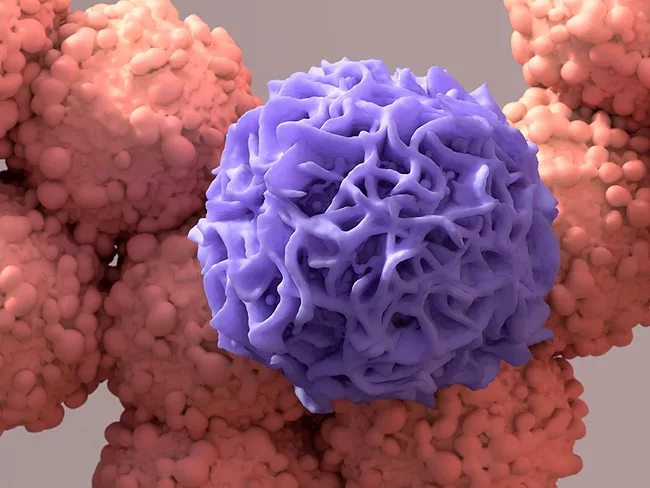
In a recently published study, researchers from Cima Universidad de Navarra and collaborators presented a novel SdAb-based CAR T-cell discovery platform that allows the generation, characterization and selection of SdAbs by several properties.
Kairos Pharma Ltd. has announced that through its academic partnership with Cedars-Sinai Medical Center, Cedars-Sinai has received $600,000 in funding from the Department of Defense lung cancer research program to advance the development of ENV-205, a new drug to treat chemotherapy drug resistance and cachexia.
Using ALK+ lung cancer patient-derived cell lines, researchers have performed phosphoproteomic screening and identified guanylate kinase 1 (GUK1) as a TKI sensitive metabolic molecule in ALK-driven lung cancer. They reported their results online in Cell on Feb. 6, 2025.
Canwell Biotech Ltd. has described antibody-drug conjugates (ADCs) comprising an antibody covalently linked to a Toll-like receptor 7 (TLR7) and TLR8 agonist through a cleavable or noncleavable linker reported to be useful for the treatment of cancer, allergy, autoimmune diseases, immunodeficiency disorder, sepsis and infections.
Institute of Cancer Research UK has identified proteolysis targeting chimeras (PROTACs) comprising a Von Hippel-Lindau disease tumor suppressor (VHL) binding moiety coupled to a receptor-interacting serine/threonine-protein kinase 1 (RIPK1; RIP-1) targeting moiety via a linker.
Hainan Simcere Pharmaceutical Co. Ltd. has synthesized protein degradation inducers comprising a regulator and/or promoter of protein proteasomal degradation moiety covalently linked to a protein targeting moiety through a linker reported to be useful for the treatment of cancer.
Gilead Sciences Inc. has disclosed protein mono-ADP-ribosyltransferase TIPARP (PARP-7; ARTD14) inhibitors reported to be useful for the treatment of cancer.
Urachal carcinoma is a rare cancer which lacks a standard drug therapy, and for which knowledge regarding its immunohistochemical features remains unclear. The aim of a recently reported investigation was finding potential markers and targets for urachal carcinoma based on antibody-drug conjugate targets, as well as its association with prognosis.
Solid tumors are difficult to treat due to their heterogeneity and limited blood supply, which restrict the effective delivery of anticancer drugs. Macrophages are abundant in solid tumor tissues and are the only cell type actively infiltrating hypoxic tumor regions, making them a promising option for delivering therapeutic agents directly to tumors.
The transcription factor nuclear factor-κB (NF-κB) family has a central regulatory role in the expression of many genes related to immune responses, inflammation, cell survival and cancer. Previous evidence demonstrated causal links between a dysregulated noncanonical NF-κB signaling and several cancer types and autoimmune diseases, yet specific inhibitors targeting this pathway remain scarce.
 RSS
RSS