What PTC Therapeutics Inc.’s latest data with votoplam might mean in the Huntington’s disease (HD) landscape became grist for Wall Street after the firm unveiled top-line results from the phase II Pivot-HD study, sharing data from the 24-month interim analysis of the long-term extension effort.
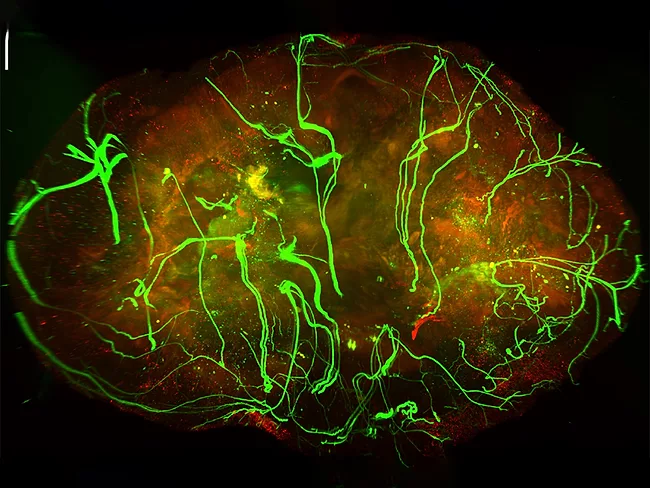
Innervation by the sympathetic nervous system is typically a boon to tumors. But researchers from Weill Cornell Medicine and colleagues have shown that in some cases, the relationship between tumors and the nervous system is more complex. Depending on context, innervation can either assist or obstruct tumor growth. “The nervous system typically has been considered as a driver of cancer growth, but here we’ve found that it can be a brake on cancer growth in some contexts,” said David Simon, an assistant professor of biochemistry and biophysics at Weill Cornell Medicine.
Rett syndrome (RTT) is a rare neurodevelopmental condition affecting multiple organ systems and is most often driven by mutations in the X-linked MECP2 gene. Researchers at Shanghai Duomirui Biological Technology Co. Ltd. have developed a new class of trofinetide prodrugs aimed at addressing limitations related to drug administration and pharmacokinetic properties.
Acurastem Inc. has been awarded $7.5 million in grant funding by the California Institute for Regenerative Medicine (CIRM) to support the advancement of lead clinical candidate AS-241 toward first-in-human testing.
Nervonik Inc. raised $52.5 million in a series B financing round for its peripheral nerve stimulation (PNS) system designed to treat patients with chronic pain and other neurological conditions. The funds will be used to support the continued development Nervonik's PNS system, including enhancements to the system’s sensing capabilities, as well as preparations for commercialization.
F. Hoffmann-La Roche Ltd. and Hoffmann-La Roche Inc. have prepared and tested new compounds acting as triggering receptor expressed on myeloid cells 2 (TREM2) agonists. As such, they are believed to be potentially useful for the treatment of rheumatoid arthritis, amyotrophic lateral sclerosis, frontotemporal dementia, multiple sclerosis, prion disease, stroke, Parkinson's and Alzheimer's disease.
In previous work, researchers from Kawasaki Medical School and collaborating institutions engineered a modified HEXB construct, modHexB, to improve GM2 ganglioside (GM2) recognition and GM2-activating protein (GM2A) interaction. The team has now combined these previous advancements to develop a new gene therapy strategy for Sandhoff disease.
If Benjamin Braddock, of The Graduate fame, were a young neuroscientist in the 21st century instead of a liberal arts graduate in 1967, the advice he received from his parents’ neighbor might not have been “One word: plastics!” but “One word: plasticity!” Plasticity is a hot concept in neuropsychiatric disorders. New and old treatment modalities, these days, are said to work as psychoplastogens or neuroplastogens.
A flurry of deals focused on the neurological disease space in 2026 suggest large biopharma companies are searching for the next best therapeutics for everything from epilepsy and narcolepsy to post-traumatic stress disorder and hyperphagia.
Grace Therapeutics Inc.’s hopes of becoming the first company in decades to update the standard of care in aneurysmal subarachnoid hemorrhage were delayed after the U.S. FDA issued a complete response letter (CRL) for its GTx-104 NDA, citing manufacturing and nonclinical deficiencies rather than concerns over efficacy or safety.
 RSS
RSS